
There’s a reaction I see almost every time a new customer turns us on for the first time. It’s surprise at how much they’re suddenly looking at. Nobody warns them to expect this much detail. Most are switching over from a program that ran on a trickle, an email survey limping along at low single digits, or a receipt code that maybe one shopper in a hundred ever typed in. Within a week, they’ve got a shift-by-shift, store-by-store answer that used to take a quarter to assemble, if it ever came together at all.
The second surprise usually lands a little later. Most people assume one question means one thing learned. Then someone on their team realizes the question doesn’t have to stay fixed. It can rotate through a bank of dozens, or trigger on the basket, the store, the daypart, whatever promotion is running that day, and still come back with a real answer from a representative slice of customers, because the volume underneath it is high enough to carry the split without falling apart.
Here’s what that first surprise looks like in practice. Paradies Lagardère operates more than 700 stores and restaurants across 92 airports in North America. Leadership already believed that a simple item suggestion at checkout could lift spend. What they didn’t have, at that scale, was any reliable way to know whether it was actually happening store to store, or what it was costing them when it wasn’t. So they put one simple question on the terminal:
“Did a team member suggest an item for you today?”
Just one of many questions they asked that day. But because that answer was tied directly to the transaction rather than floating free the way a satisfaction score usually does, it answered two questions at once. Customers who got a suggestion spent 10% more per transaction. And only half of stores were pulling off the behavior more than 60% of the time. One of many clear strategic gaps they identified quickly.
That single gap, alone, was worth an estimated $1.8 million in recoverable revenue. Not from a new product. Not from a new pricing model. From knowing which stores were actually doing the thing everyone had already agreed was worth doing.
Yes, it’s true that a receipt survey could eventually tie an answer back to the original transaction, once enough people scan the code, and someone joins the responses to the sales data, months later. The connection isn’t the problem. The detail is. It would take months – maybe years – to identify the stores and shifts that reliably had a problem. That’s not data you can action. You only act on a gap like this when there’s the real-time detail, every week, every store, and every shift, tied to what was actually bought, where, and when, allowing teams to address shift-level issues in the moment. That’s the whole premise of transaction-linked feedback… relevant questions, asked at the moment of payment, to nearly every customer, tied to what was actually bought, where, and when.
While it’s second nature to me after working at TruRating, I realize that these tremendous capabilities are often not obvious at first. So here are seven things I think every retail and restaurant leader evaluating customer feedback tools should understand when looking at a transaction-linked feedback program like TruRating.
1. It’s part of the transaction, not a separate ask
Every traditional survey program asks the customer to do something twice: complete the purchase, and then, separately, decide to tell you about it. A receipt with a URL. An email that shows up that evening, competing with forty other emails.
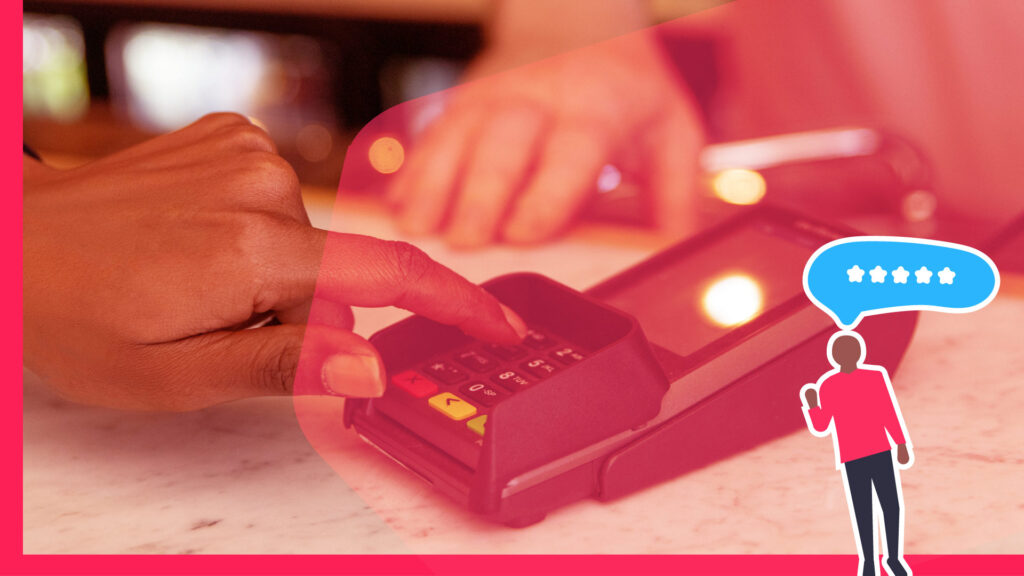
Transaction-linked feedback skips the second ask entirely. The question shows up inside the payment experience itself, while the visit is still fresh and before the customer’s attention has moved on to whatever’s next. That’s not a UX nicety; it’s the entire reason the participation numbers look so different between the two approaches.
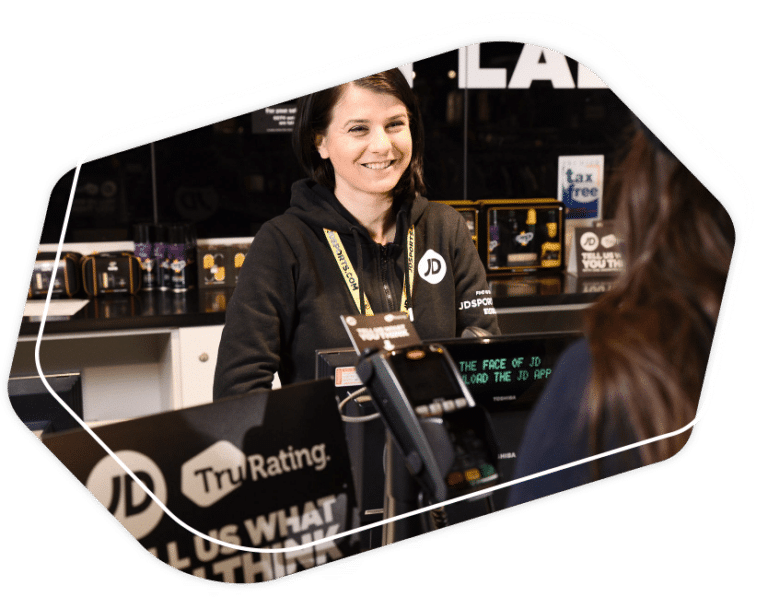
It also happens to make life easier at the store level. We’ve done studies to show that there’s no significant difference to the time at the till for customers; the feedback happens seamlessly, in a single keypress, as part of the transaction. No separate processing needed, no complex script for associates to remind customers to save their receipts. And no extra costs for additional paper or incentives.
Meanwhile, the data coming back for merchants is enriched, continuous and comprehensive.
2. It closes the participation gap
Here’s the number that should bother more CX leaders than it does: receipt-based surveys average under 1% response, and email surveys typically land around 5%. Those numbers aren’t wrong, exactly. They’re just answering a different question than the one most people think they’re asking. They tell you what your angriest and happiest customers think – and yes, they can let you reach out to them to make things better in those cases when things go wrong. But they aren’t giving you an actionable barometer on what the majority of your customers are thinking and feeling when they’re in your store.
That gap is important because people are missing what the representative majority of customers think – the ones that actually drive your brand and your sales.
That’s the participation gap: the distance between the sliver of customers who volunteer an opinion and the full population of people who actually paid you.
But participation by itself isn’t actually the point. A brand could hit a high response rate and still have nothing useful if every answer came back as one blended score for the whole chain. What closing the participation gap actually buys you is a sample that’s granular and representative at the same time: enough responses, from enough of your real customer base, that you can break the number down by store, shift, and daypart and trust that it reflects who walked through the door that day, not just who felt strongly enough to say something.
TruRating’s payment-terminal feedback runs at 84% participation, on average, because the question is asked in the flow of the transaction itself, anonymously, with one keypress. At that level, you’re not looking at a sample anymore. You’re looking at something close to the whole store’s worth of customers on a given day.
That changes what you’re allowed to do with the number. A 1% sample tells you a story about your most vocal customers. An 84% sample tells you something closer to the truth about your business, shift by shift, store by store, daypart by daypart.
This is why we say TruRating can be something like mystery shopping, but supercharged. Mystery shops let you actually see what’s happening at one store, and one particular time of day, during one person’s visit. They’re great for correcting the behaviors and issues spotted in that moment in that store. But that’s just one visit, for just one store. TruRating gives you that for every hour, every day, and every single store, continuously.
3. It shortens the distance between a problem and the fix
A traditional program has a lag built into it that can be days, sometimes weeks, before enough responses trickle in to see a pattern. Because of the high participation rate, transaction-linked feedback collapses that. A service issue, a stocking problem, a staffing gap, any of it can show up in the same shift it happens, broken down by store, region, or daypart.
I think about this in terms of what store managers can actually do with the information. A pattern that surfaces once a quarter gets an apology and a plan for next quarter, with no real way to identify if this was just one customer’s experience or a particular problem with a shift. A pattern that surfaces that afternoon gets a coaching moment with that day’s staff, and a fix before the next trading day. Those are not the same intervention, even if the underlying insight turns out to be identical.
4. It arrives already wired into the P&L
An NPS® dashboard devoid of revenue impact is a strange kind of data… It gives you a read on customers’ satisfaction with a specific channel in comparison to others, but no way to tell whether it’s worth investing in making improvements to that channel. And while one longitudinal survey may tell you where things are going wrong for one customer, it can’t tell you what’s a consistent problem worthy of a fix.
Transaction-linked feedback comes pre-joined to spend, items, location, channel, and time of day, along with a hashed identifier for when that customer comes back. Which means you know not only where, precisely, issues are happening consistently, but the return on investment for a fix. It also allows you to benchmark new initiatives, test new products and marketing efforts with ease, and quickly get a read on the impact of merchandizing.
For example: New store launches can be quickly measured for how much a redesign is impacting consumer perception, how that ties to spend, and whether a small store with a new, improved layout is going to perform better over time than an established flagship, even if week 1 sales are lower.
Or how a campaign, a promotion, BOGO offer, or an in-store activation is registering with shoppers, and whether that awareness is leading to more return visits.
Or whether a new product or menu item is the right color, style, or flavor to get customers to buy it again.
Or whether you’ve got the right sizes, brands, or selections on the shelf to get customers to put one more item in their cart even after the holiday rush is over.
None of these insights are new, necessarily. Marketing and merchandizing often conduct these types of studies. What’s new is having an always-on mechanism to gather this data instantly as a continuous data stream, from every store and nearly every customer, at no additional cost, any time you want; while simultaneously being able to improve channel-level and store-level execution day by day.
5. It turns on a capability sitting inside hardware IT already paid for
Most feedback programs die at the infrastructure stage, long before anyone gets to argue about the data. A new kiosk nobody trains staff on. A tablet with some smiley faces by the door that gives you broad sentiment summaries. An app most customers never bother to download, let alone rate on.
Every one of those is a new capital request, a new device for IT to secure, a new line item requiring ongoing maintenance. Meanwhile, the payment terminal already sitting at checkout is more capable than most retailers ever use it for. It’s already been through procurement. Already PCI-certified. Already integrated with the POS. Already trusted enough to process a customer’s card, which is a higher bar than most new feedback hardware ever clears.
TruRating’s transaction-linked feedback activates through that same card reader, whether that’s a retail register, a restaurant counter, a drive-thru lane, or a table-side terminal. It’s a capability switched on inside an investment IT already made and continues to manage, not a new investment asking to be justified: no new device for a manager to charge and maintain, no data science project with its own timeline. Most retailers simply ask their payment partner to switch us on.
For teams who build their own payment application, TruRating’s MCP-enabled development portal means that our API integration can be mapped to a merchant’s custom stack in a matter of minutes. For a multi-site brand, that’s the difference between a pilot that’s live in weeks and one that’s still stuck in procurement next quarter.
6. One question at a time still builds a wide picture
The objection I hear most often is that you can’t run a business off a single question. A traditional survey asks fifteen. This asks one. Surely you’re trading depth for participation?
That’s simply not true. This concern arises from the fact that people have gotten so accustomed to such low participation rates, they feel that everything needs to be gotten in whenever they’re lucky enough to get someone to respond. TruRating’s massive participation flips that on its head.
Yes, each customer answers once. But it doesn’t have to be the same question every time. It can rotate from a bank you’ve set in advance, or trigger on context: what’s in the basket, whether the customer is a loyalty member, which store, which daypart, whether a promotion was running. Ask about checkout speed, cleanliness, marketing effectiveness, a specific product attribute driver, and associate availability in a single rotation, and you’ll have all of these answered by a representative set of real paying customers within a matter of minutes. That’s a LOT more responses to all questions than you’ll get from the occasional customer answering all fifteen. And you don’t have to worry about survey fatigue and question sequence biases.
Let’s call it the depth assumption… the belief that richer insight requires a longer survey. That holds when you’re asking one person. It stops holding the moment you’re asking nearly everyone.
And something that many people don’t realize is that not all questions need to be asked at the same frequency. If you want to get a shift-level read of service behavior at every store, you’ll ask those questions often. But if you want a general sense of why customers chose your brand? A fraction of the responses will do, and still give you a statistically significant answer within days. By weighting different questions differently, you can get data across multiple question dimensions simultaneously; the only limit now is how quickly your teams (and AI agents) can react to the new information.
7. It’s what AT agents need to pair the why with the what, in real time
An AI agent making a pricing, staffing, or inventory call already has the what: the sales number, the transaction count, the redemption rate. What it’s missing is the why, and a free-text comment or a satisfaction score collected days later doesn’t close that gap fast enough to matter. By the time a batch of survey responses gets classified and joined to last week’s sales, the decision the agent needed to make already happened.
Transaction-linked feedback closes both distances at once. The answer is tied to the specific transaction, at the specific store, on the specific shift, so an agent isn’t left guessing whether a sales dip and a service complaint are related. It can see they’re the same event. And it lands on a dashboard, enhances a database or enriches a customer model within about an hour, not at the end of a reporting cycle. A pricing agent checking whether a markdown protected or eroded value perception needs that answer before it scales the test to the next hundred SKUs, not a quarter later.
Many people don’t initially realize the value that having this first-party dataset provides to their data science teams. But after those teams get a hold of it, the models they build begin powering systems throughout the business they never realized were possible.
The real question isn’t survey versus no survey
It’s whether you’re willing to find out what your actual participation rate is, and whether you’re ready for what it tells you. A well-run traditional survey can still answer real research questions. But if the job is managing a large, multi-site retail or restaurant operation day to day, a 1% sample and an 84% sample are not the same instrument, no matter how similar the scores look on a dashboard.
I’ve watched enough new customers go live to know the pattern by now. Week one, they’re stunned by how much detail just showed up, store by store, shift by shift, in days instead of a quarter. A few weeks later, they’re stunned again, this time by how many different questions that same keypress can carry without losing any of that detail. Not long after that, their data science team quietly starts building things on top of it that nobody asked for at the start. A first-party dataset this granular and this fast turns out to be useful in more places than a feedback report, especially once the AI agents running their pricing, inventory, and merchandising decisions start asking for it too.
That’s the real shift. Not a better survey, but a live, granular read on most of your customers, precise enough for a store manager, fast enough for an AI agent, deep enough for research, and cheap enough to run everywhere, all from data you already collect.
You can keep evolving off the opinions of the customers who felt strongly enough to tell you something unprompted. Or you can find out what the other 84% have been thinking the whole time but didn’t have the time to tell you. When Paradies started listening, they found a $1.8 million opportunity hiding in their stores – and that was just the start. I’m always eager to learn what opportunities our customers are finding next.
Useful resources
- Real-time customer feedback and customer experience
- AI in retail – how it’s changing the retail industry
- Retail customer analytics your AI agents are missing
- Survey fatigue – why your customers stopped answering
- How to measure customer service
Net Promoter®, NPS®, NPS Prism®, and the NPS-related emoticons are registered trademarks of Bain & Company, Inc., NICE Systems, Inc., and Fred Reichheld. Net Promoter ScoreSM and Net Promoter SystemSM are service marks of Bain & Company, Inc., NICE Systems, Inc., and Fred Reichheld.