A strong retail conversion strategy helps you turn more of the traffic already entering your stores into sales. If you are working out how to increase conversion in retail, or how to drive conversion in retail across a store network, the first step is identifying the cause of low conversion before choosing the tactic.
The goal is not to apply the same conversion tip across every location. It is to find where conversion is being lost, understand why it is happening, and give store teams a practical action they can take.
Download the 2026 Guide to In-Store Conversion
See the customer behaviors and in-store conditions that influence conversion, and learn how to turn store-level insight into measurable action.
Retail conversion rate in one minute
Retail conversion rate is the percentage of store visitors who complete a purchase.
A good retail conversion rate depends on your category, location, store format, season, and the intent of the traffic entering the store. Industry ranges can provide context, but your own store and daypart baseline is usually more useful than a broad average.
Why is my retail conversion rate low?
If you are trying to understand how to improve conversion in retail, start by separating three different problems:
Traffic quality
Staff availability and behavior
Friction at the point of purchase
These causes need different fixes.
A staffing change will not solve poor traffic quality. More sales training will not fix an out-of-stock problem. And a promotion may increase footfall without improving the experience that turns those visits into transactions.
Use store, shift, and daypart data to distinguish between them.
What you see
Possible cause
What to measure
First action to test
Traffic rises but conversion falls
Lower-intent traffic or campaign mismatch
Traffic source, promotion, customer mission
Compare promoted and non-promoted periods
Conversion drops during busy periods
Low staff-to-traffic ratio
Footfall, labor coverage, approach rate
Reallocate coverage to peak trading hours
Customers browse but do not buy
Limited help, unclear value, or poor product findability
Help offered, price perception, dwell time
Test proactive help in matched stores
Conversion falls in specific stores
Local execution or inventory problem
Stock availability, queue length, service behavior
Review stores by shift and daypart
Conversion falls across the store network
Pricing, assortment, campaign, or wider operational issue
Category, region, format, and time trends
Isolate what changed before applying a fix
The important step is to move from “conversion is down” to a more specific statement.
For example:
Conversion falls after 4 p.m. when the staff-to-traffic ratio declines.
Stores with lower product availability convert fewer visitors.
Conversion drops during periods when checkout queues grow.
Customers who cannot find an associate are less likely to buy.
That gives the business something it can test.
Start with a conversion number you can trust
To increase conversion rate in a retail store, you first need confidence in both sides of the calculation: transactions and visitors.
Retail conversion is also described as footfall conversion or walk-in conversion. It measures how many store visitors complete a purchase, but it sits within a wider traffic journey.
Capture rate measures how many people passing a location enter the store. Conversion rate measures how many of those visitors buy. Sales per visitor then shows how much revenue the store generates from each person who enters.
Looking at these measures together helps separate different problems:
A low capture rate may point to window displays, signage, location visibility, or campaign relevance.
A healthy capture rate with weak footfall conversion suggests the problem is inside the store.
A strong conversion rate with low sales per visitor may point to basket size, product mix, or pricing.
Transaction counts from the POS are usually clear. The visitor number can be less reliable. A retail traffic counter measures entries, but those entries may include:
Employees
Deliveries
Children
Returning customers
People entering more than once
Pass-through traffic
Store layout, counter placement, and the number of entrances can also affect the denominator. This does not make people counting useless. It means the number needs context.
Check whether:
Employees and deliveries are excluded where possible.
Each entrance is measured consistently.
Repeat entries are treated the same across stores.
Traffic data is aligned with trading hours.
Transactions and footfall use the same reporting period.
Store formats with different traffic patterns are compared separately.
A small change in the denominator can make conversion appear to rise or fall even when customer behavior has not changed. That is why conversion should be reviewed alongside staffing, stock, queues, customer feedback, and other retail metrics.
One of the most practical answers to how to improve conversion rate in retail stores is to improve shop floor coverage when customers are most likely to need help.
A weekly labor schedule may look efficient in total but still leave individual shifts understaffed. If associate availability falls during lunch, after work, or on weekends, shoppers may struggle to:
Find a product
Check stock availability
Compare options
Find another size or color
Get reassurance before buying
Complete the purchase quickly
Track the staff-to-traffic ratio by hour rather than reviewing labor cost only at store level.
Look for:
Conversion falling when footfall peaks
Long periods without visible associate coverage
High dwell time followed by low conversion
Lower approach rates on particular shifts
Queue growth around breaks or shift changes
Stores with similar traffic but different labor patterns
The answer is not always to add more labor. It may be to move existing coverage.
For example, you could:
Shift administrative tasks outside peak periods
Stagger staff breaks
Assign clear shop floor zones
Introduce a queue trigger for opening another register
Move experienced associates into high-friction periods
The objective is to make help available when hesitation is most likely to become abandonment.
Improve selling behaviors on the shop floor
When considering how to increase store conversion rate, focus on observable behaviors rather than broad instructions to deliver better service.
Useful behaviors include:
Greeting the customer
Offering help without applying pressure
Asking what the customer is looking for
Checking another size, color, or location
Explaining product differences
Making a relevant product recommendation
Helping the customer use a fitting room
Confirming the customer found what they needed
These actions can reduce uncertainty and help customers make a decision. But the right behavior depends on the category and customer mission.
An airport electronics store may benefit from fast product demonstrations. A fashion store may need stronger fitting room support. A high-volume value retailer may need clear product findability and fast checkout.
The challenge is usually consistency. Retailers often know which behaviors should happen, but they cannot see whether those behaviors are happening across every store and shift.
At Hanes Australasia, customers who were offered fitting room help had an 18% higher average transaction value. That relationship does not prove that fitting room assistance directly caused the full increase. But it gave the business a clearer view of how fitting room engagement, size availability, and execution consistency were linked with spend.
The analysis also showed where support was less consistent across stores, helping Hanes focus coaching where it could have the greatest commercial impact. Improving fitting room support for an additional 5% of customers revealed a potential 1% revenue growth opportunity.
This creates a more useful coaching conversation than telling every location to sell more. Store teams can see the behavior being measured, where it is breaking down, and what to practice next.
Use personalized recommendations carefully
Personalized recommendations can support conversion when they make the decision easier for the customer.
That may mean recommending:
A compatible accessory
An alternative size or color
A product suited to the customer’s stated need
A replacement for an unavailable item
A complementary item that improves the original purchase
The recommendation should be relevant.
A generic upsell can introduce friction, particularly when the shopper is already uncertain or short of time.
Measure:
Whether recommendations were offered
Whether customers found them useful
Whether the relationship with conversion remains consistent
Whether ATV or UPT changed
Whether results varied by store, shift, or category
Avoid assuming that higher spend alone proves the recommendation caused the result.
Remove friction at the point of purchase
Effective retail store conversion rate optimization strategies remove the practical barriers that stop an interested shopper from completing a purchase.
Improve stock availability
An out-of-stock item can end the customer journey immediately.
Track customer-reported availability alongside inventory records to identify:
Phantom stock
Misplaced items
Poor shelf replenishment
Size or color gaps
Differences between system availability and the customer experience
When an item is unavailable, give associates a clear alternative.
That could include:
Checking another store
Arranging home delivery
Suggesting a suitable substitute
Helping the shopper order online
Reserving stock for collection
Reduce checkout wait time
Queue management protects the final stage of conversion. Customers who have already decided to buy can still abandon the purchase when checkout feels slow or disorganized.
Track:
Queue length
Checkout wait time
Abandoned baskets
Customer feedback
Register availability
Performance by daypart
Set clear triggers for opening another register. Keep complex service issues away from the main payment queue where possible. For self-checkout areas, make sure help is available for age checks, payment problems, and scanning errors.
Improve store layout and wayfinding
Customers should be able to understand where to go, how categories are organized, and where to find help.
Review store layout when you see:
High traffic but low category engagement
Repeated questions about product location
Long dwell time without purchase
Congestion around displays
Poor visibility of fitting rooms or checkout
Lower conversion after a layout or format change
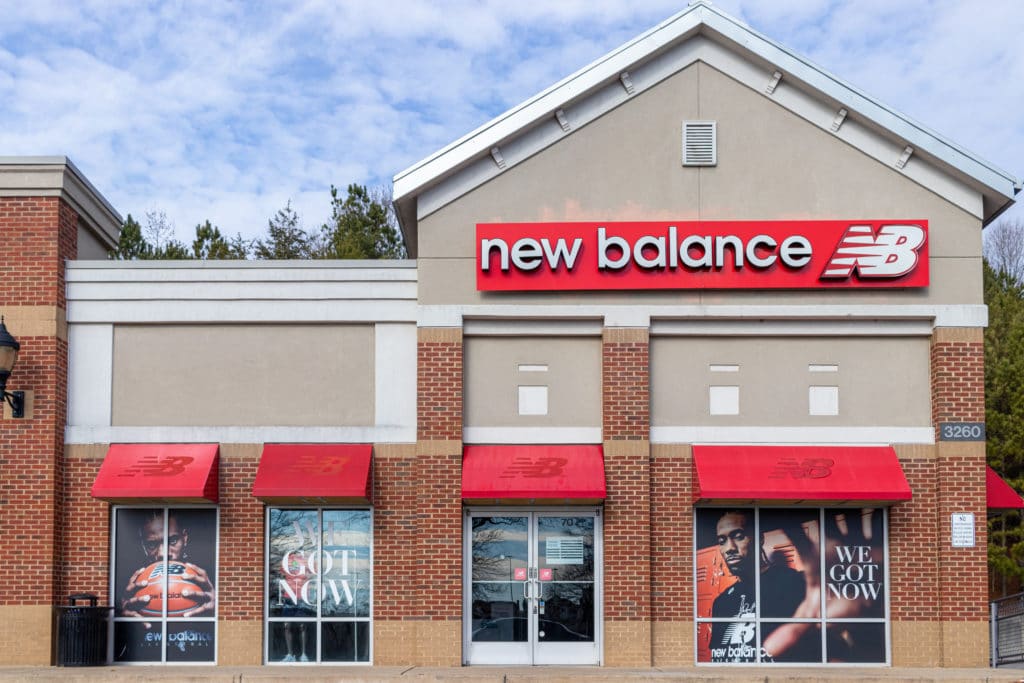
New Balance used a four-week test and control approach to evaluate a new store layout, comparing one redesigned outlet with its existing stores. During the trial, TruRating collected more than 25,000 customer responses alongside transaction data.
The redesigned store outperformed the existing outlets across nearly all measured areas, with customer satisfaction scores increasing by almost 8%. Scores in the control stores declined during the same period, giving New Balance clearer evidence that the new format was performing differently and the confidence to proceed with the refurbishment.
Promotional traffic does not automatically convert.
Customers may leave when:
The offer is difficult to understand
Exclusions are unclear
Promotional signage is inconsistent
The shelf price does not match the expected checkout price
The discount applies only to products that are unavailable
Test promotional comprehension, price fairness, and signage clarity during the campaign rather than waiting for the final sales report. This helps distinguish weak demand from weak execution.
How to improve retail conversion quickly
The most useful retail conversion tips are the ones that can be tested without changing the whole store model.
Actions to take this week
Review conversion by store, hour, and daypart.
Compare footfall with scheduled labor coverage.
Check the five stores with the largest recent conversion decline.
Review queue length during peak trading.
Check availability for the highest-demand products.
Coach one observable selling behavior.
Ask customers one focused question at checkout.
Useful questions include:
Did you find everything you needed?
Was help available when you needed it?
Was checkout quick and easy?
Did a team member offer useful help?
Keep the question connected to the issue you are trying to solve.
Do not ask a broad satisfaction question when the suspected problem is staffing, stock, or checkout.
Actions to take over the next four weeks
Run a controlled test using comparable stores.
Choose:
A small group of test stores
A matched control group
One operational change
A clear baseline period
A defined test period
Conversion, ATV, UPT, and margin measures
A customer or execution signal explaining why performance changed
Do not roll out a tactic simply because conversion rose once.
Check whether:
The result was repeated
Traffic quality changed
Promotional activity affected demand
Margin declined
ATV or UPT changed
The behavior was executed consistently
The result held across different dayparts
Measure whether your retail conversion strategy worked
To drive retail conversion consistently, measure both the result and the execution behind it. Conversion tells you whether more visitors bought. It does not tell you why.
Add measures that test the proposed cause.
Conversion initiative
Result measure
Execution or customer measure
Improve peak-hour staffing
Conversion by hour
Help availability and approach rate
Reduce checkout friction
Conversion and abandonment
Queue length and checkout ease
Improve product availability
Conversion by category
Customer-reported availability
Coach product recommendations
Conversion, ATV, and UPT
Recommendation offered and usefulness
Change store layout
Conversion and dwell time
Findability and ease of navigation
Run a promotion
Conversion and margin
Offer clarity and price perception
This prevents teams from scaling the wrong conclusion.
For example:
Conversion may improve after a staffing change because traffic quality also changed.
A promotion may increase conversion while reducing gross margin.
A layout trial may perform well overall but fail during specific dayparts.
Higher ATV may be linked with a behavior without proving that behavior caused the full increase.
The strongest analysis combines:
Footfall data
Transaction data
Staffing and operational information
Customer feedback
Store, region, shift, and daypart context
A test and control structure where possible
TruRating captures one question at checkout and links the response to the transaction. With 84% response rate, retailers can collect a high-volume signal from paying customers and analyze it by store, shift, basket, and other transaction attributes.
That does not replace a retail traffic counter. It adds the customer and execution context needed to understand why conversion differs and where teams should act.
Retail conversion should not be optimized in isolation.
Conversion shows how many visitors completed a purchase.
Average Transaction Value (ATV) shows the average amount spent per transaction.
Units Per Transaction (UPT) shows the average number of items in each basket.
A tactic that raises conversion but reduces ATV, UPT, or margin may not improve total store performance.
Review the measures together. Better queue management may protect conversion without affecting basket size. Strong fitting room support may help customer confidence and increase ATV. Relevant cross-selling may increase UPT, while aggressive upselling may create friction and reduce conversion.
The objective is not the highest possible conversion percentage. It is sustainable revenue growth from a store experience customers find easy, useful, and consistent.
Turn conversion insight into store action
The hardest part of improving retail conversion is rarely finding another list of tactics. It is identifying which problem exists in which store, then giving field teams enough evidence to act.
A useful retail conversion strategy should help you answer:
Which stores are losing sales despite strong traffic?
At what times does performance decline?
Is the issue staffing, behavior, stock, layout, price, or checkout?
Which stores execute the desired behavior consistently?
Can the result be repeated without damaging margin?
What should each store team focus on next?
This is where customer feedback becomes operational performance data rather than another dashboard.
TruRating links customer signals to transactions so retailers can compare stores, shifts, and dayparts, identify execution gaps, test improvements, and give field teams clearer coaching priorities.
That supports the practical outcome retail teams need, meaning less guesswork, faster intervention, and more consistent execution across the store network.
Download the 2026 Guide to In-Store Conversion to see the full data behind what really moves conversion, and how to turn everyday behaviors into measurable revenue lift
Answers to common questions about improving conversion in retail stores.
How do you increase conversion in a retail store?
If you are asking how to increase conversion in retail, start by identifying why customers leave without buying, then test a focused fix. Common priorities include matching staffing to traffic, improving product availability, making help easier to find, clarifying prices and promotions, and reducing checkout wait times.
How do you drive conversion in retail?
If you are asking how to drive conversion in retail, measure performance by store, shift, and daypart, then connect changes in conversion to staffing, stock, selling behaviors, and customer feedback. This helps you act on the cause of low conversion instead of applying the same tactic across every store.
How can I improve conversion rate in retail stores?
Improve conversion rate in retail stores by comparing locations with similar traffic and identifying what stronger stores do differently. Review staff-to-traffic ratios, approach rates, product availability, queue length, store layout, and the consistency of key service behaviors.
How do you increase store conversion rate?
Start with one measurable conversion barrier and run a controlled test. For example, improve peak-hour coverage, coach associates to offer help, or set a queue trigger for opening another register. Then compare conversion, ATV, UPT, margin, and customer feedback against the original baseline.
Why is my retail conversion rate low?
A low retail conversion rate may be caused by low-intent traffic, limited staff availability, poor product findability, stock issues, unclear pricing, confusing layouts, or slow checkout. Review the pattern by store, shift, and daypart before deciding which problem to fix.
How do personalized recommendations increase conversion rates in retail?
Personalized recommendations can increase conversion when they reduce uncertainty or help the customer find a suitable alternative. Recommendations should reflect the customer’s stated need, product compatibility, availability, and price range rather than relying on a generic upsell.
How do you increase conversion rate in online retail?
Online retailers can increase conversion by improving site speed, navigation, product information, search relevance, checkout simplicity, and delivery clarity. This guide focuses on in-store conversion, where staffing, product availability, store layout, and human interaction have a greater influence.
At TruRating, we capture real-time, transaction-linked feedback at scale. Integrating with point of sale systems and other touchpoints, we provide retail businesses with reliable customer insights to drive improvements, enhance experiences, and boost performance.
Improving ATV – how to get your frontline to think “sales”, not just “service
Request a demo
Connect with a TruRating representative for more information about our solutions.
You’ll be in great company...
“We use TruRating to confirm what customers actually notice and respond to positively, which allows us to quickly roll out a plan based on real data. Then we can double down on what works across our stores.”
ALDI
“With other CX programmes, the stats never matched what we observe in store because of low response rates. With TruRating, the numbers make sense.”
JD Sports
“TruRating provides a consistent, up-to-date view of performance across every channel, it brings our business together in a way no other tool has.”