
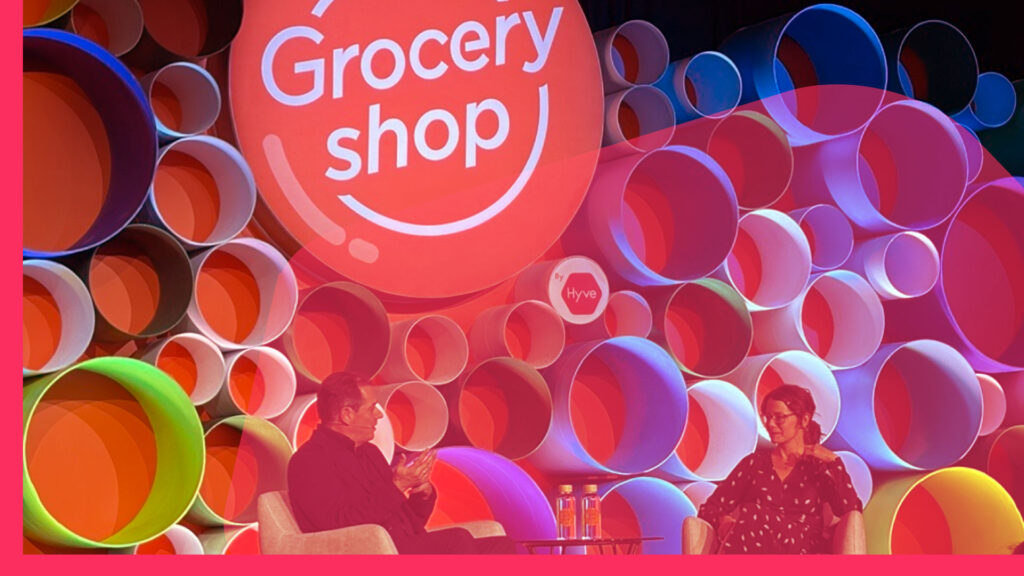
Groceryshop 2026 brought the grocery industry to Mandalay Bay in Las Vegas from September 22–24 for three days of conversations about AI, retail media, value, ecommerce and the future of the physical store. Across sessions from Kroger, Ahold Delhaize, Instacart, Hy-Vee and leaders in retail media, the consistent question was how technology solves a real customer problem.
Key takeaways from Groceryshop 2026
- Ahold Delhaize: Start with a customer problem, then find the technology that helps solve it.
- Instacart: AI has an opportunity to take more of the work out of grocery shopping.
- Kroger: Better digital experiences only work when the physical operation can deliver on them.
- Hy-Vee: Value now stretches beyond price into service, quality, convenience and health.
- Retail media: In-store media only scales if it protects the customer experience.
- Measurement: As stores add more technology, retailers need to see what customers experienced as well as what they bought.
Yael Cosset captured the broader theme early in Kroger’s session:
“Customers don’t wake up and say, ‘I’m going to shop online today’ or ‘I can’t wait to go into the store.’ They have needs, they have occasions they try to address. And it’s on us to remove that friction.”
Yael Cosset, EVP & Chief Digital Officer, Kroger
Ahold Delhaize: start with a problem worth solving
Albert Heijn’s approach to AI provided one of the clearest examples of starting with the customer rather than the technology. Its AI assistant, Steijn, was built around a problem almost every grocery household recognizes… deciding what to have for dinner. It can help customers work around different dietary requirements, find suitable recipes and move those choices into a shopping list.
Sjoerd Holleman described the thinking behind it simply:
“Stick with the customer and always start where the value is. Talk about real customers, real challenges and real solutions.”
Sjoerd Holleman, Chief Product, AI & Specialty Brands Officer, Ahold Delhaize
Holleman was also open about launching something that was never going to be perfect from day one.
“Everybody expects us to be perfect. And we know AI isn’t really going to be perfect.”
Sjoerd Holleman, Ahold Delhaize
Albert Heijn introduced Steijn to customers as young and still learning, asking them to bear with it as the experience improved. The retailer then kept learning from how customers actually used it.
One lesson came from placement. When Albert Heijn brought Steijn closer to search and the main shopping experience, usage increased.
“You need to bring your innovation as close as possible to the customer journey… because that’s where the high traffic is and that’s where we can make a difference.”
Sjoerd Holleman, Ahold Delhaize
The technology worked better when it became part of something customers were already doing.
Instacart: AI can take more of the work out of grocery shopping
Chris Rogers approached AI through the amount of work still involved in a grocery shop. Households have to balance budget, dietary requirements, preferences, promotions, what is already at home and what is actually available. Then they repeat the exercise a few days later.
“We’re really just giving the app to the consumer and they’re doing all the work.”
Chris Rogers, CEO, Instacart
For Rogers, AI changes that balance.
“It’s gonna be able to anticipate your needs because it understands the intent.”
Chris Rogers, Instacart
That was one of the clearer shifts across the AI discussions at Groceryshop. The conversation is moving beyond where to put an AI assistant and toward how technology can reduce the decisions and actions required from the shopper.
Kroger: the digital promise has to hold up in the store
Kroger’s session brought the operational side of AI into focus. Cosset argued that customers do not think about shopping in the same channel-based terms retailers often use internally. They have a need and expect the retailer to help them solve it, whether that happens online, in an app or in a store.
A better digital experience therefore creates a higher expectation for what happens next. Cosset gave the example of AI helping someone shop for the ingredients needed for a favorite Thanksgiving recipe. If the customer then reaches checkout and the retailer cannot supply a particular size or spice, that’s “a big black eye.”
That is why Kroger’s AI work also extends “behind the shelf,” into forecasting, replenishment and fulfillment. And while much of the discussion focused on removing friction, Cosset also argued against reducing grocery to a purely functional transaction.
“Food is a source of emotional connection in families, with friends, and we are all about bringing that to life for our customers.”
Yael Cosset, Kroger
Technology can remove work, improve relevance and improve availability. But what happens in the store still has to deliver on what came before it.
Hy-Vee: value is broader than price
Value was another recurring theme at Groceryshop. Hy-Vee CEO Jeremy Gosch described competitive pricing as increasingly becoming the baseline rather than the retailer’s complete value proposition. Hy-Vee matches prices across its top 15,000 items, then looks to service, fresh quality, private label, convenience and health to give customers a reason to choose it.
That broader proposition includes pharmacies, dietitians and food-as-medicine programs, alongside investment in its fresh offer and private label. Gosch described service in simple terms:
“Whatever the customer needs, whenever they want it, wherever they want it.”
Jeremy Gosch, CEO, Hy-Vee
Price matters. So do availability, speed, quality, relevance and service. The difficult part for retailers is understanding which of those things is making the difference.
In-store retail media: measuring sales is only part of the picture
The physical store was also central to the retail media discussion. Screens, audio, point-of-sale placements and other surfaces are opening more opportunities for retailers and brands to reach customers close to purchase. Much of the panel focused on how to establish the incremental sales those placements create.
But growth in in-store media also puts more pressure on the customer experience.
“If you can promise that you will deliver a great CX in store, then it’s much easier to get the merchant buy-in. It’s good for the consumer, it’s good for the brands, it’s good for the retailers.”
Andrew Lipsman, Independent Analyst & Consultant
Parbinder Dhariwal brought the discussion back to the person walking through the store:
“Just think about yourself as a customer, right? Like, I have a need.”
Parbinder Dhariwal, VP/GM, CVS Media Exchange
The panel spent plenty of time on incrementality. If somebody sees an in-store campaign and then buys the advertised product, how much of that sale was actually caused by the media? There is another question alongside it:
What did the activation do to the customer experience?
As stores carry more media, technology and new interventions, sales measurement only tells part of the story. Retailers also need to know whether those changes made the experience clearer and more useful, or simply added noise. That becomes particularly important around checkout, where the experience and transaction meet.
TruRating at Groceryshop: the experience behind every sale
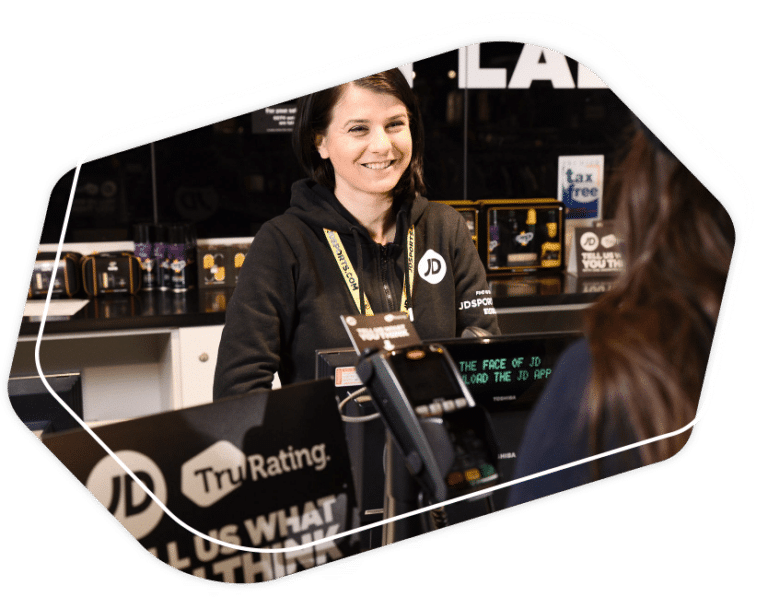
TruRating asks one anonymous, skippable question at payment while the customer is checking out. Enough customers answer to see how the experience differs by store, shift and daypart, rather than as one estate-wide score. And because each answer sits beside what was bought, retailers can see which parts of the experience are associated with differences in spend.
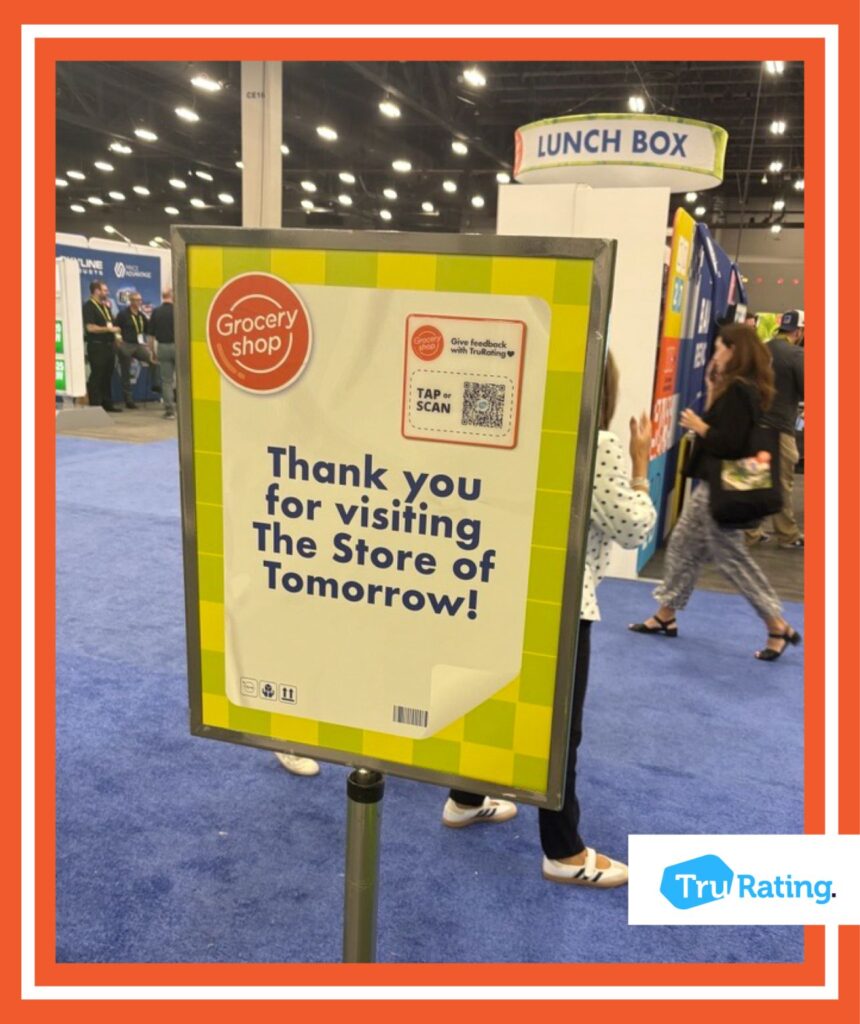
The payment moment matters because the person answering has just paid, and the experience is still fresh. It asks nothing of them later. But not every important experience ends in a transaction.
At Groceryshop, we also showcased Tap to Rate, which takes the same one-question approach beyond payment. A customer taps their phone on an NFC tag or scans a QR code, the question opens in the browser and they answer there and then.
For grocers, that can extend measurement into places such as collection points, service counters, fresh food areas, new store concepts or retail media placements.
What Kroger’s AI launch revealed about customer assumptions
One of the smaller moments in Kroger’s session also showed why listening still matters. Before launching its AI shopping assistant, Cosset had assumptions about which customer segments would be most likely to use it. Adoption turned out to be much more evenly distributed than expected.
The lesson is, retailers now have more ways to anticipate demand, personalize experiences and predict what customers may do next. But customers will still surprise you. As retailers introduce more AI, automation and media into stores and digital experiences, seeing what customers actually experienced gives teams a way to test those assumptions against reality. Holleman’s advice toward the end of his Groceryshop session was a fitting way to summarize the week:
“Make sure you stay close to the customer and double down on what makes you unique.”
Sjoerd Holleman, Ahold Delhaize
AI is moving quickly. Retail media is moving deeper into stores. The definition of value is broadening. And retailers are finding new ways to connect digital tools with physical operations. But across Groceryshop 2026, the starting point remained remarkably consistent: understand the customer problem first.
Want to see how that looks in practice? Explore TruRating Retail Intelligence to see how retailers connect what customers experienced with what they bought, and turn it into a clearer view of performance across the estate.