

If you’re looking for how to increase sales in retail, it’s usually not because you’re short on ideas. It’s because the same levers don’t work as reliably anymore, and store-to-store execution gaps get expensive fast.
What’s changed in 2026 is that value for consumers isn’t just price anymore. Deloitte’s recent research points to a structural shift toward value-seeking behaviours, and notes that a meaningful share of “value” comes from things other than price, like checkout ease, service, and employee attitudes. NIQ also flags trust as a deciding factor for most consumers, which puts day-to-day execution right in the middle of commercial performance.
TruRating’s own consumer polling backs that up. In our 2025 Holiday Shoppers Report, we surveyed 20K+ shoppers across grocery, convenience, fashion, and luxury and found customers aren’t necessarily spending less. They’re spending more deliberately by planning more, comparing more, and judging value “in the moment.” And that “value” judgement is increasingly about clarity, convenience, and time not being wasted, not just the ticket price.
That’s why in-store sales execution has become so important. We see across retail how frontline behaviours can materially shift basket outcomes. Simple staff behaviours like greeting, offering help, and demonstrating product features are associated with meaningful increases in average transaction value across verticals.
The goal of this guide isn’t “more tactics.” It’s about providing you with a repeatable way to run sales performance as an operating discipline, by focusing on the biggest leaks, coaching the staff behaviors that move conversion and basket size, and building consistency across every store and every shift.
The 3 levers to increase retail sales
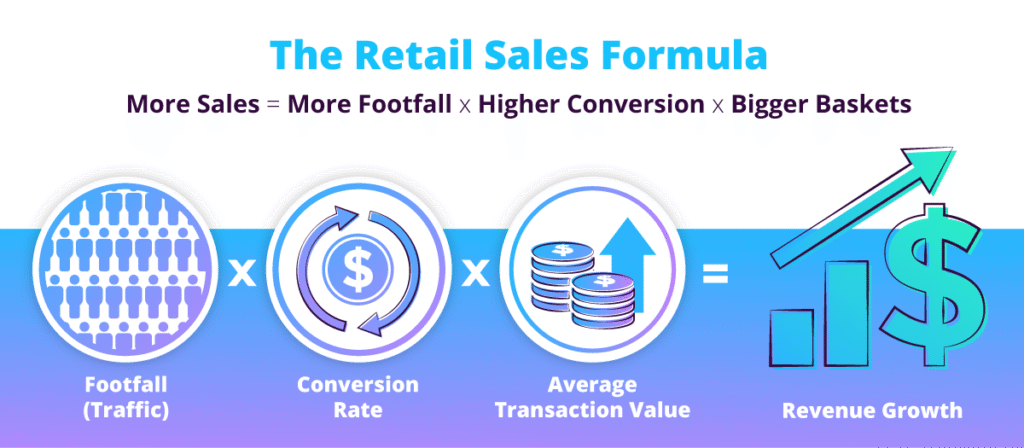
If you want ways to increase sales in retail, keep it simple. Most store growth comes down to one model:
Sales = Footfall (Traffic) × Conversion Rate × Average Transaction Value
Quick definitions
- Footfall / traffic: how many people enter the store (people counting helps).
- In-store conversion rate: the % of visitors who buy.
- ATV / average transaction value (average ticket size): revenue per transaction.
- UPT / units per transaction: items per basket.
Most stores over-focus on traffic. The quickest gains usually come from conversion + basket because you can control them shift-by-shift.
Strategy 1–3: Use the model as your weekly operating system
- Pick one lever to improve each week (conversion or basket).
- Pick one root cause to attack (queues, coverage, availability, confidence).
- Measure results by store, daypart, and shift so you can see what’s real.
Quick wins to increase retail sales this weekx
If you’re asking how to increase store sales or how to improve sales in retail quickly, start with fixes that remove obvious friction. These are classic retail sales tips because they don’t require a big budget, just a clear plan and follow-through.
10-point checklist for the next 7 days
- Fix peak-hour coverage: match staffing to traffic patterns (not yesterday’s rota).
- Standardise greet + offer help: make it non-negotiable for first 30 seconds.
- Reduce queue abandonment: visible queue host, clear priorities, fast problem-solving.
- Improve product visibility: endcaps, clean signage, and “best sellers” at eye level.
- Tighten planogram compliance: reduce “where is it?” moments and dead space.
- Add-on prompts at checkout: one helpful suggestion, not a script dump.
- Speed up self-checkout: one “fixer” on duty during peak trading.
- Protect stock availability on winners: refill cadence + simple gap checks.
- Give staff product knowledge cues: cheat sheets, top Q&As, “3 things to know”.
- Track daily: visitors, transactions, ATV, UPT (and top walkaway reasons).
Strategy 4–10: Turn quick wins into habits
- Put “peak hours / peak trading” on every schedule template
- Run a 10-minute “queue reset” drill before lunch and after school run
- Add a “top 10 sellers in stock” check at midday
- Move one hot category to an endcap and re-measure conversion
- Add a single line to daily huddles: “What are we seeing customers struggle with?”
- Put one manager on “service coverage”, not “task coverage”, at peak
- Share yesterday’s conversion and one action for today
Increase conversion rate in-store
Traffic gets the attention, but in-store conversion rate tells the truth. If you’re figuring out how to increase sales in a retail store, conversion is where the most “hidden” sales leakage sits, because shoppers often don’t leave the store, they just leave without buying when small frictions stack up.
In our recent in-store conversion guide, we highlight that the main drivers of missed conversion:
Why conversion drops (common causes)
- Help isn’t available at the “moment of need”
- Browsers don’t get supported into a decision (hesitation stays high)
- Coverage doesn’t match peak trading
- Checkout feels unmanaged (queue abandonment)
Strategy 11: Close the “help gap” to lift in-store conversion
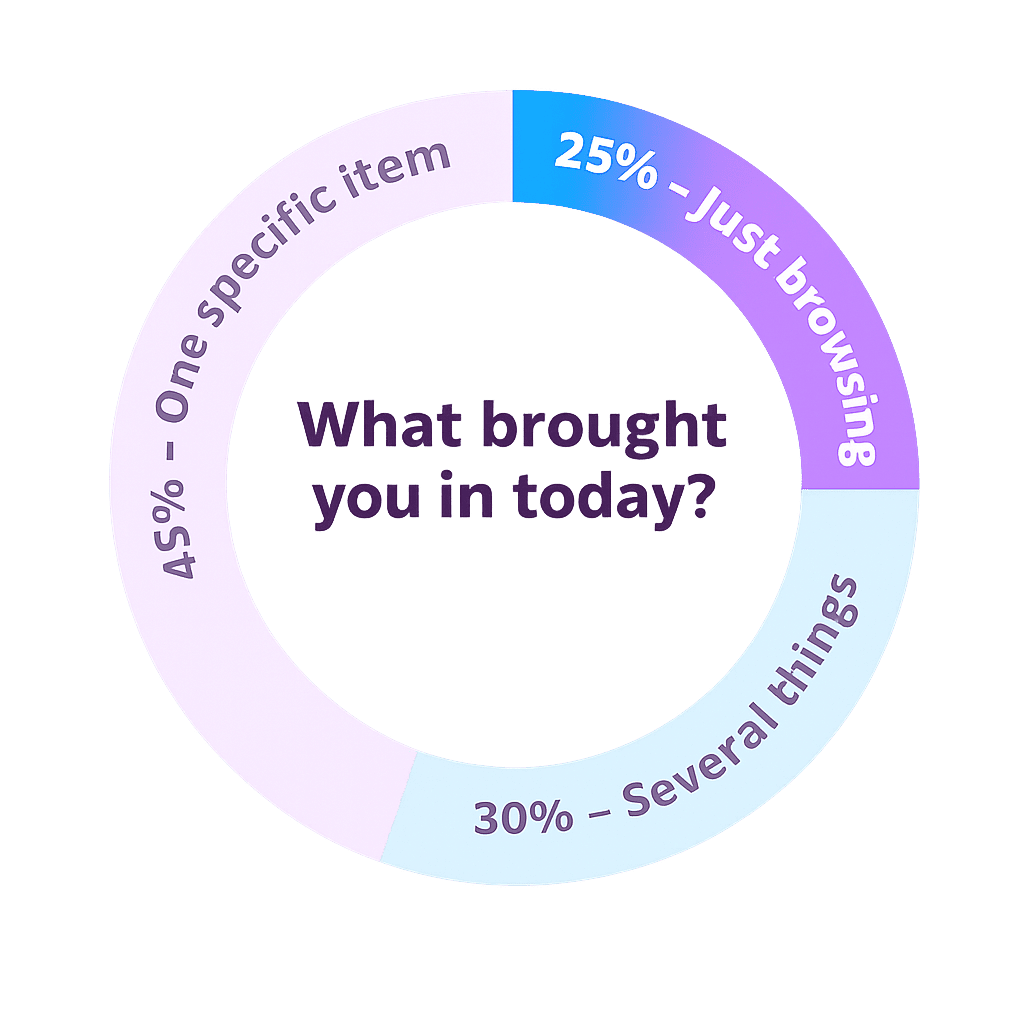
Let’s start by saying that browsing is not a dead end. In TruRating’s 2025 consumer polling across retail verticals, when shoppers were asked, “What brought you in today?”, 25% said they came in “just to browse.” Rather than signalling low intent, this type of indicator shows that decisions are still being made in-store, and the right help, clarity, and confidence at that moment is what truly turns browsing into buying.
We also found that customers who report being offered help spend 26% more per transaction than those who weren’t, especially among browsing shoppers, where early engagement often decides whether the visit converts at all.
Do this (this week):
- Coach your team to greet (keep it natural).
- Track conversion by daypart so you can see where the “help gap” is worst.
Strategy 12: Expand greetings with proactive support
Conversion lift doesn’t come from hard selling; it comes from reducing uncertainty at the right moment. When someone steps in early, with one relevant question and one clear recommendation, shoppers decide faster, and baskets grow.
Do this:
- Ask one discovery question before recommending
- Offer one relevant add-on tied to the shopper’s need.
- Keep it natural. Confidence beats scripts
Strategy 13: Match staffing to traffic
If you want to increase store sales, look at coverage during peak footfall, not just total labour hours. One footwear brand we work with saw a persistent gap in in-store conversion rate between outlet and full-price stores. By analysing TruRating’s real-time customer feedback alongside operational data, one factor stood out: staff availability during peak periods.
In lower-performing stores, limited coverage aligned with weaker conversion. When they ran a controlled test, increasing payroll and investing in associate training in select outlet stores, the results were that a 10% increase in staff coverage drove an 8% lift in conversion, building a predictive business case tied to a $16.7M revenue opportunity.
The lesson is, don’t just add labour. Align coverage to traffic and decision moments.
Do this this week:
- Identify peak 30-minute trading windows.
- Protect service coverage during those periods.
- Move tasks outside peak hours.
Strategy 14: Reduce hesitation with product confidence (knowledge + demos)
Uncertainty is one of the biggest barriers to conversion. Perception matters as much as speed; simple behaviours like acknowledging the wait, communicating clearly, and visibly managing queues can protect conversion during peak periods.
Do this (this week):
- Create a “30-second demo” for one category (features + use case + reassurance).
- Put a named queue owner on peak shifts to reduce walkaways.
Download the 2026 Guide to In-Store Conversion to see the full data behind what really moves conversion, and how to turn everyday behaviors into measurable revenue lift
Retail sales training that actually changes behavior
Most retail sales training fails because it isn’t tied to revenue. Retailers heavily invest in modules, playbooks, and service standards, but on the floor, behaviour varies by store, shift, and manager. Without visibility, coaching becomes generic. And generic coaching doesn’t move conversion, ATV, or UPT in a measurable way.
The real question isn’t “Did we train the team?” It’s “Did behaviour change, and did sales move?” That’s the shift leading retailers are making so that training no longer becomes a compliance exercise, but actively helps drive revenue.
What to train
Focus on behaviours that influence decisions in real time:
- Greeting and discovery
- Confident recommendations
- Simple objection handling
- Add-on selling without pushiness
- Checkout tone and speed
Strategy 15: Train micro-skills tied to one metric
Don’t train everything at once. Determine the most important KPI and tie them to training.
- Conversion week: greet → discover → reassure
- UPT week: add-on prompts → bundle framing
- ATV week: trade-up guidance → better/best positioning
When one behaviour links to one metric, managers can coach with clarity and measure impact.
Strategy 16: Make coaching visible and normal
Coaching works when it’s frequent and expected.
- 5-minute daily huddles
- 2-minute on-floor corrections
- 3 quick role-play reps
- One metric focus per week
The goal is rhythm, not intensity.
Proving behavior drives ATV
Retailors, Nike’s partner in Australia and New Zealand, suspected that asking customers for their name created connection. But they didn’t know if it actually impacted average transaction value, or whether staff were doing it consistently.
Using TruRating, they introduced one question at checkout: “Did staff ask your name today?” Within two weeks, they had compliance data across every store. The impact was:
- Stores with 100% compliance on asking a persona name saw a 30% uplift in ATV.
- After reinforcing the behaviour through coaching, they saw an average 1.7% increase in weekly revenue per store.
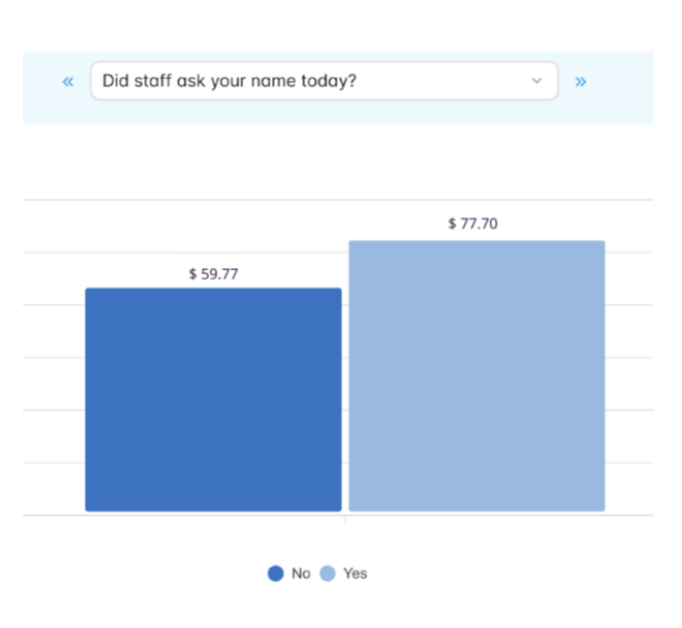
The point isn’t that asking a name is revolutionary. It’s that simple behaviors, consistently measured and reinforced through coaching, can drive significant commercial impact.
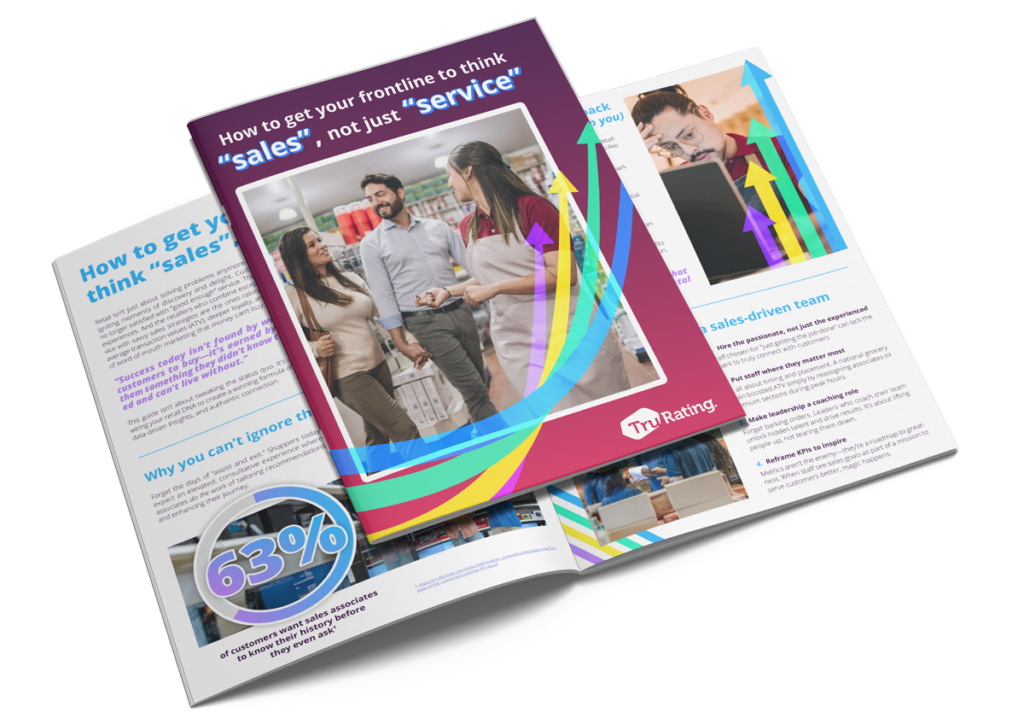
Want to learn more? Download our ATV guide on “How to get your frontline to think “sales” not just “service”.
From training to measurable performance
TruRating’s TruCoaching AI turns real-time customer feedback into weekly, store-specific coaching plans. Managers see which behaviours lift conversion and ATV in their store, not in theory, but in practice. Instead of generic training cycles, stores get:
- Clear weekly priorities
- Behaviour-to-revenue linkage
- Visibility by store and shift
- Proof of impact on sales
Across retailers, we consistently see that small targeted behavior shifts compound over time. And what works in your best stores can be replicated across your entire estate.
If you want to turn retail sales training into a performance engine, learn more about TruCoaching and see how behaviour-led coaching drives measurable growth.
Increase basket size with add-on selling
If you’re looking for how to increase sales in a retail shop, basket-building is often the cleanest win, especially when traffic is flat.
Cross-sell vs upsell with simple examples
- Cross-sell: add a related item (batteries with a torch, socks with shoes)
- Upsell: trade up to better value (basic blender → more powerful model)
Strategy 17: Use an “add-on ladder” to increase ATV and UPT
Keep it simple with a framework of Good / Better / Best
- Good: the essential add-on
- Better: the convenience add-on
- Best: the “complete solution” bundle
Example (clothing):
- Good: socks
- Better: belt
- Best: outfit add-on (layering item) + care product
Checkout prompts and bundles without discounting
Helpful prompts beat forced scripts:
- “Do you need X to go with that?”
- “Most people grab Y because it makes this easier.”
- “If you’re using it for Z, this option holds up better.”
Strategy 18: Add one basket prompt per department per day
Pick one add-on theme daily:
- Monday: accessories
- Tuesday: care products
- Wednesday: bundles for “mission shopping”
Rotate so it doesn’t feel stale.
Retail sale promotion ideas that don’t destroy margin
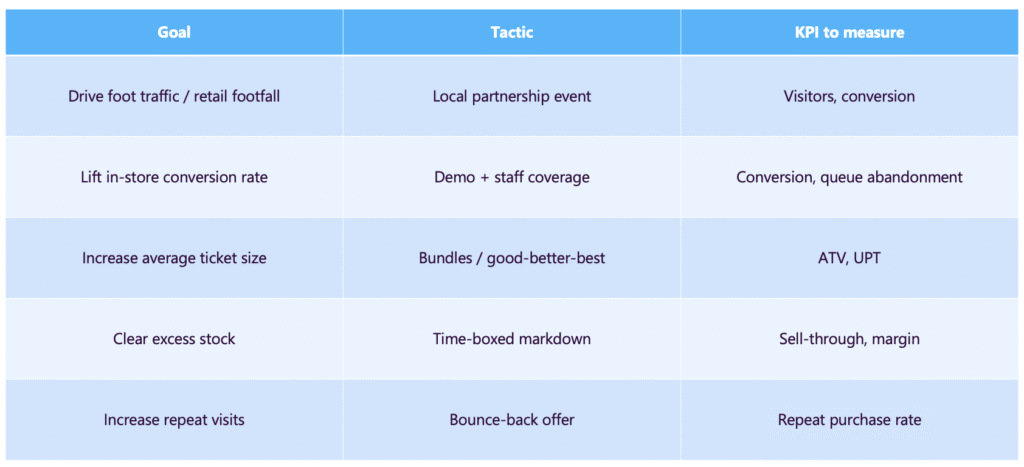
If you need retail sale promotion ideas or sales promotion ideas for retail, start by deciding what you’re trying to change: traffic, basket size, or repeat visits. Too many promotions run without a clear goal, then get judged on gut feel.
Promotion ideas by outcome
Traffic drivers
- In-store events (product demos, mini services)
- Partnerships (local gyms, cafés, schools)
- Limited-time drops (small but clear)
Basket builders
- Bundles (solution packs)
- Threshold offers (spend £X, get Y)
- “Buy more, save more” with tight guardrails
Repeat purchase
- Loyalty program boosts (double points on a category)
- Bounce-back offers (next visit incentive)
- Service reminders (refill, care, replacement cycles)
Clearance discipline
- Controlled markdowns with clear exit rules
- Don’t let clearance clutter your prime zones
Strategy 19: Use a promotion planning checklist
Before you launch:
- What’s the goal: traffic, conversion, ATV, UPT, repeat rate?
- What’s the baseline and time window?
- What could distort results (stockouts, staffing gaps, weather, local events)?
- What’s the “stop rule” if it’s not working?
Promotion ideas matrix
Staffing, scheduling and service coverage
If you’re trying to boost retail sales without extra headcount, your first move is usually smarter coverage. Labor scheduling that ignores store traffic patterns creates the same pain every day: busy periods understaffed, quiet periods overstaffed.
Strategy 20: Match staffing to traffic, then protect “service time”
Use a simple rule: service before tasks during peak hours.
- Build rotas around peak trading blocks or, if you’re using TruRating, when service scores are lowest
- Set a customer-to-staff ratio target for your target hours
- Move replenishment, delivery, and admin to low-traffic or high-score windows
Strategy 21: Use daypart patterns, not weekly averages
Weekly averages hide the truth. A store can “hit labour %” and still leak sales through poor coverage at the wrong times.
Inventory availability and in-stocks
If you want to improve retail sales, don’t skip this. Stock availability is the easiest “yes/no” reason a customer can’t buy.
Strategy 22: Protect in-stocks on known winners
- Identify top sellers by daypart and day of week
- Build a refill rhythm (morning, midday, late afternoon)
- Track out-of-stock rate for your “must win” SKUs
- Use TruRating to ask the question “Did you find everything you need today?”
Strategy 23: Reduce out-of-stocks with a simple gap routine
- “Top 20 scan” twice per day
- Backroom “quick locate” process
- Clear ownership: who fixes gaps, and by when
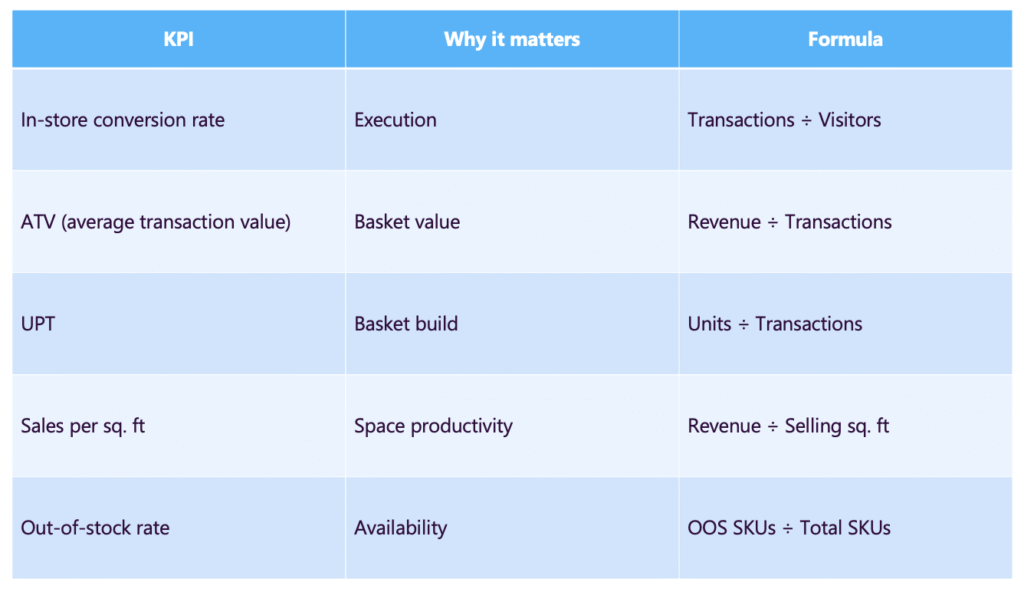
KPIs to track with formulas and a weekly rhythm
If you want snippet-friendly answers (and better store control), these are the KPIs that matter. This is also where sales per square foot retail becomes useful, as it gives you a reliable space productivity signal.
KPI table
Strategy 24: Run a simple weekly rhythm
Daily (5 minutes)
- Conversion, ATV, UPT
- Top category winners/losers
- One friction insight (queues, stock, service)
Weekly (30–45 minutes)
- Promo performance vs baseline
- Staffing vs traffic patterns
- One coaching focus for next week
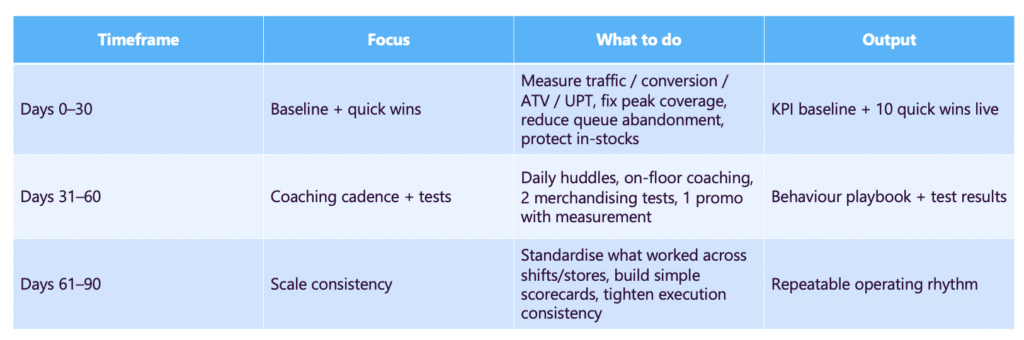
30/60/90-day action plan to increase retail sales
If you want to know how increase retail sales without burning the team out, you need sequencing. Fix basics first, then layer in tests, then standardise.
Bringing your retail sales strategy together
The gap between high-performing stores and the rest usually comes down to small staff behaviours that get missed. Without clear visibility, it’s hard to know what to coach, where conversion is leaking, or why one store outperforms another.
That’s why the retailers seeing the strongest results aren’t adding more initiatives. They’re simplifying. They focus on a small number of staff behaviours that directly impact in-store conversion rate, ATV, and UPT, measure them in real time, and reinforce them through consistent coaching.
Because in retail, performance is built through small actions, repeated consistently, across every store and every shift. And when you can see which behaviours lift sales (and where they’re not happening), you move from guesswork to a scalable framework. Coaching becomes targeted. Managers act with confidence. And improvements don’t stay isolated to one store. The goal isn’t just to track performance, it’s to make it visible, actionable, and repeatable. That’s exactlyt what TruRating enables.
If you want to see how our customer feedback platform can pinpoint where conversion is leaking and turn it into daily coaching actions, speak to the TruRating team about a demo.
Useful resources
- Perceived value in retail – how experience shapes pricing, loyalty, and spend
- Retail conversion guide – definition, formula, benchmarks, fixes
- How to measure customer service – metrics and tools
- Real-time feedback and customer experience – the new standard for retail
- How to improve customer experience in retail stores
FAQ
How can I improve retail sales quickly?
Focus on conversion and basket before you chase more traffic. Fix peak-hour coverage, reduce queue abandonment, and coach one service behaviour for a full week. Track conversion, ATV, and UPT daily so you can see what’s moving.
How do you increase sales in retail without discounting?
Use add-on selling and bundling to lift basket size, and remove friction that blocks conversion. Discounts can lift traffic, but consistent service behaviours and better checkout flow often lift sales without margin damage.
What is a good in-store conversion rate?
It depends on category, location, and store format. The useful benchmark is your own trend: track conversion by store and daypart, then aim for steady improvement by removing the biggest friction points.
How do I reduce queue abandonment?
Use clear queue management: assign a queue owner during peak trading, trigger extra tills based on queue length, and keep problem-solving away from the till. For self-checkout, keep one “fixer” available for age checks and scan issues.
What is ATV and how do I increase it?
ATV is average transaction value (revenue per transaction). Increase it by using good/better/best recommendations, bundles, and helpful add-ons at the point of decision—without turning it into a hard sell.
How do I increase units per transaction (UPT)?
Make one relevant add-on suggestion tied to the customer’s need, and keep add-ons visible in the right places (near the product, at checkout, and in endcaps). Coach the same add-on theme for a full week.
How do I calculate sales per square foot in retail?
Sales per square foot = Revenue ÷ Selling square feet. Use it to spot space productivity issues, not to blame stores. Pair it with conversion and traffic so you know what’s driving the result.
What retail KPIs matter most weekly?
Conversion rate, ATV, UPT, sales per square foot, and (if you can) out-of-stock rate on top sellers. Review weekly with staffing vs traffic patterns and one coaching focus.