
Consumer insights in 2026 Q1 tell a more useful retail story than a simple value-versus-values split. The latest quarter of TruRating data shows that shoppers are not separating neatly into bargain hunters on one side and purpose-led buyers on the other. They are moving between both modes, often within the same category and across the same period.
That matters because it changes how retail leaders should think about pricing, brand storytelling, frontline coaching, and in-store decision-making. TruRating’s latest polling report draws on more than 78,000 validated point-of-payment responses across grocery, value and department retail, athletic and footwear, and premium specialty, giving this view more immediacy than a lagging survey or post-period sales report.
What Q1 2026 retail consumer insights are telling us
Shoppers are under real price pressure, but still expect brands to be trustworthy, relevant, and aligned with their values. NIQ’s recent report shows ethical sourcing and sustainability have become baseline expectations rather than differentiators, while last year’s Yale Budget Lab analysis points to steep tariff-driven pressure on shoes and apparel prices. And ICSC’s 2026 post-holiday survey found that 63% of shoppers were more selective because of higher prices, even as 47% still spent more than they had planned. That is the operating tension retailers are dealing with right now: caution has risen, but willingness to spend has not disappeared.
The value of our Q1 2026 consumer insights is that it connects that macro backdrop to what shoppers are actually saying at the moment of payment. Instead of treating inflation, tariffs, trust, private label, and ethical shopping as separate topics, it shows how they are colliding in real retail environments. The big takeaway is brands need to stop asking what type of shopper this is, and start asking what mode they are in today. That framing is the real story of the quarter.
Explore our interactive consumer insights report
The shopper paradox defining Q1 2026
The clearest consumer behavior insights, in Q1 2026, come from the idea that value-seeking and values-led shopping are overlapping behaviors, not opposing identities. Shoppers are making tighter decisions, but that does not mean they have stopped caring about ethics, trust, provenance, or quality.
In fact, NIQ’s 2026 outlook says 95% of consumers see trust as important, and that shared-value attributes now act more like entry requirements than nice extras. So the question is no longer whether a shopper cares more about price or values in general. It is what they need help resolving in this moment.
That matters because a lot of retail execution still assumes static segments. One plan is built for the discount shopper. Another is built for the premium shopper. Another is built for the ethical buyer. But the data suggests those lines are not nearly as fixed as retailers think. The same customer may be comparing prices in one aisle, buying a gift in another, and paying more for a product they trust if someone helps them understand why it is worth it.
Finding 1: Value-seeking and ethical shopping now coexist
The strongest brand insights in the data come from the first finding. In value and department retail, roughly 42% to 49% of shoppers were seeking promotions in a typical week, while 45% to 51% said they actively try to shop for ethical brands in those same stores and weeks. In premium specialty, ethical brand preference ran even higher, from 55% to 71% across Q1. This is the core paradox, that value-seeking did not crowd out values-led behavior. It sat alongside it.
That changes how retailers should think about segmentation. The assumption has always been that a more price-conscious customer is less open to a values story. But the data points in the opposite direction. A shopper looking for a deal may still care deeply about where a product comes from, how it was made, and whether the brand feels credible. That does not mean every shopper will pay a premium. It means values still shape choice, even when price sensitivity is high.
This is especially important for merchants and frontline teams. Ethical sourcing should not live only in brand copy or packaging. It needs to be translated into practical selling language.
- Why is this product better made?
- Why is this brand worth trusting?
- Why is this item a better gift, better long-term value, or better fit for what the shopper is trying to do?
In premium environments, that protects margin. In value environments, it helps justify choice. And in both, it gives staff a more useful conversation than price alone. NIQ’s broader 2026 work supports that direction: trust and values now help brands stay in consideration, even if they no longer guarantee conversion by themselves.
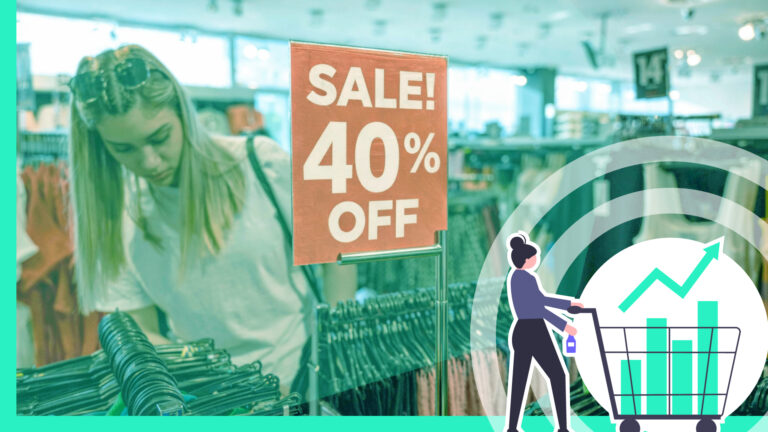
The apparel data makes this even more apparent. Discount-seeking was the highest of any vertical in the dataset, at 75% to 82% in most weeks, yet gift purchasing still ran at 30% to 51%. That means some of the most price-aware shoppers are still buying with intent, care, and emotion. Retailers that treat every discount-led basket as a low-value, low-attention transaction are likely missing an opening. A gift buyer often wants help. And help, when it is relevant, it moves spend.
Finding 2: Tariffs and inflation are making shoppers more selective
The biggest consumer insight in the second finding is about timing. Tariffs and inflation are continuous pressures. The report suggests shoppers are already adapting before more impact shows up on the shelf. In athletic and footwear retail, discount-seeking rose from about 33% to 34% in late February to 43.7% by the first week of April, a ten-point jump in roughly six weeks. That lines up with Yale Budget Lab’s estimate that 2025 tariffs could push short-term shoe prices up by 40%, with long-term shoe prices still 19% higher after adjustment. The business implication is that shoppers are pre-adapting. They can sense where prices are heading, and they are shifting into more deliberate, discount-first behavior ahead of the full impact.
But the data also shows that not every category is moving in the same way. Grocery looks steadier. Between 59% and 61% of shoppers arrived with a list, and 55% to 61% were meal-prepping for the week. This is not the same kind of reactive deal-seeking seen in discretionary categories. It is more disciplined and planned. For grocery operators, that means availability, navigation, and execution matter even more. Planned shoppers are less forgiving when the shelf is wrong, the layout is confusing, or the intended item is missing. They are not browsing their way into a bigger basket. They are trying to complete a mission.
This is where retail teams need to be careful not to flatten all cautious spending into one story. Some shoppers are trading down. Some are trading across. Some are holding spend for the products or categories that still feel worth it. And some are staying highly selective while remaining willing to spend when the offer feels relevant.
Finding 3: The 50/50 brand decision is still being made in-store
The most commercially useful shopper insight in the third finding sits in one stubborn number. Half the shopper base is still open to spending more on a name brand. In value and department retail, the “yes” response ranged from 45.3% to 52.0% across the quarter. That is not drift. It is durable indecision. And that means the branded-versus-own-label choice is still being made on the floor, not just in the planogram.
If private label is now seen more often as a credible first-choice option, and branded products still pull roughly half the room, then merchandising alone cannot settle the contest. The outcome depends on what the shopper sees, understands, and hears in the moment. A strong own-label proposition needs clarity and confidence. A branded proposition needs relevance beyond a logo. That is where the frontline matters.
Our own data of over one billion customer responses makes the commercial case clear. We see that relevant product recommendations can lift average spend by up to 32% in some verticals, and even a warm greeting can lift spend by 20.2%. So this is not just a branding issue or a pricing issue. It is an execution issue. The undecided shopper is not a dead end. They are an active conversion opportunity. And in a more selective market, relevance becomes the deciding lever.
For retail leaders, that should reshape where effort goes. It is tempting to focus only on price architecture, promotional cadence, or assortment mix. Those still matter. But the data shows that in-store explanation is part of the commercial system now. If a shopper is undecided, a well-timed recommendation, a clear explanation of provenance, or a sharper articulation of product value can be the difference between a lower-value basket and a higher-value one. In 2026, relevance is a frontline capability.
What this means for retail operators and frontline teams
For operators, these retail consumer insights only matter if they change execution.
The first step is to stop segmenting purely by wallet. The same shopper will show up in different modes on different visits. So teams need better cues. Basket mix, questions asked, time spent in category, sensitivity to promotions, and openness to provenance all tell you more than broad demographic assumptions.
The second step is to make the values story usable on the floor. If shoppers still care about ethics and trust under pressure, store teams need language that connects those ideas to practical purchase decisions.
The third step is to treat undecided shoppers as revenue opportunities, not passive traffic. If half the room is still open on branded spend, then recommendation quality matters. Not generic upsell. Relevant guidance.
The fourth step is measurement. Operators need real-time store, shift, and daypart visibility so they can coach faster, spot friction earlier, and separate a store problem from a format problem.
That is also why this quarter’s paradox is key for operators to understand. If value-seeking and values-led shopping now coexist, then the winners will be retailers that can read that shift in real time and adapt store execution around it. Better coaching. Better recommendations. Better validation of what is working. Less guesswork.
See how TruRating helps you turn real-time shopper feedback into clear, measurable actions that improve conversion, ATV, and in-store performance. Book a demo today.