
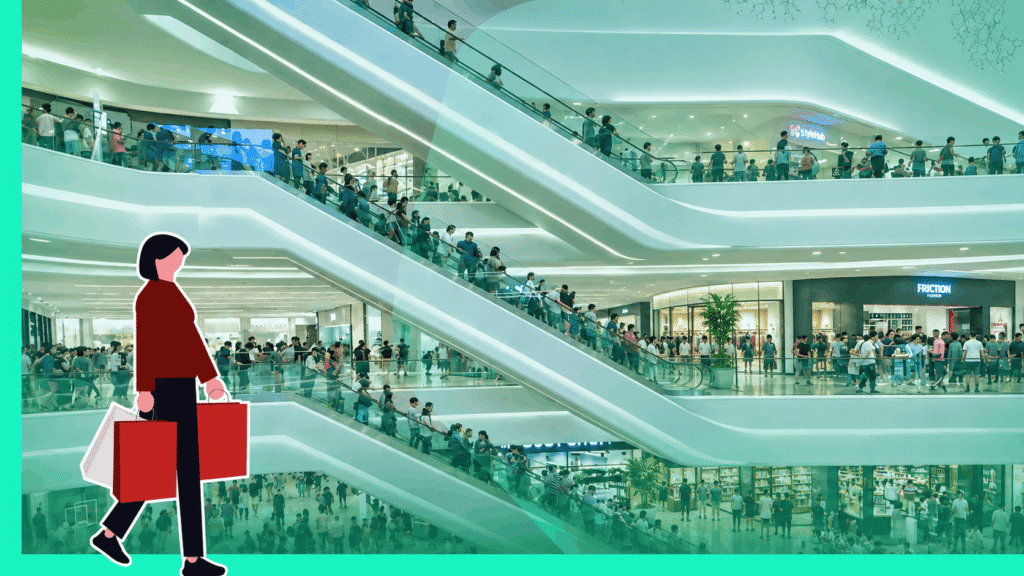
Black Friday shopping trends 2026 point to another demanding day for store teams. On Black Friday 2025, 3 p.m. was the busiest hour for US store visits. Across a group of retailers we sampled, stores put through nearly two and a half times as many transactions as on an ordinary Friday. Every retailer in the group was busier.
The test for November 27 is whether stores serve that crowd as well as they serve shoppers on a normal day. Last year’s registers were busier and baskets bigger, and at most retailers in the group, fewer shoppers said they were greeted. We look at the forecast, what shoppers told us at payment, and how teams should prepare. For wider context on shoppers’ price concerns, see our Holiday Retail Trends report.
Black Friday 2026 at a glance
The National Retail Federation (NRF) forecasts November and December US retail sales growth of 4.2% to $1.013 trillion. Shoppers also plan to concentrate more of their shopping around Thanksgiving weekend.
| 2026 outlook | Figure | What it means in store |
|---|---|---|
| US holiday retail sales forecast | Up 4.2% to $1.013 trillion | Prepare for demand, with plans tailored by format. |
| Likely to wait until Thanksgiving weekend for most holiday shopping | 64%, up from 51% five years ago | Staff and replenish for a concentrated rush. |
| Holiday shoppers planning to shop online | 53%, lowest share since 2015 | Keep knowledgeable people on the sales floor. |
Sources: NRF, October 15, 2026 and NRF, October 28, 2026.
Black Friday falls on Friday, November 27, 2026, after Thanksgiving. Cyber Monday follows on November 30.
Black Friday 2025 statistics: what the national numbers show
The NRF’s December 2, 2025 survey counted 202.9 million shoppers over the five-day weekend, including 80.3 million in store and 85.7 million online on Black Friday. Shoppers spent $337.86 on average on gifts and seasonal purchases across the weekend.
Adobe’s December 2, 2025 report recorded $11.8 billion in US online spending on Black Friday, up 9.1% from 2024.
Sensormatic Solutions reported on November 29, 2025 that US store visits were down 2.1% year over year but were about three and a half times the Friday before. Traffic peaked from 2 p.m. to 4 p.m., with 3 p.m. the busiest hour. Its traffic comparison uses one preceding Friday; our checkout comparison below uses the average of four.
Mastercard SpendingPulse reported on November 29, 2025 that US retail sales excluding autos grew 4.1% year over year across stores and online.
Together, these reports show the scale of the day. The checkout data adds what shoppers experienced inside the store.
What happened at checkout on Black Friday 2025
Across a group of retailers we sampled, completed transactions rose and most retailers also saw higher spend per transaction, measured through average transaction value (ATV).
The higher checkout volume came with pressure on everyday service. Two further findings help explain what stores should look at before the next peak.
| What we saw | Finding | What it means on the floor |
|---|---|---|
| Why service deserves attention | Shoppers who said a team member greeted them, offered help or suggested an item spent 12.05% more per transaction than shoppers in the same stores who said no. | Use the behaviors linked to higher spend to focus your shift briefings and coaching. |
| Different formats, different peaks | Travel and grocery retailers we sampled saw no Black Friday lift. | Plan staffing by format and local demand instead of applying one peak-day schedule everywhere. |
The 12.05% service-spend comparison comes from our wider proactive customer service benchmark.
Service under pressure: what shoppers said
Black Friday 2025 showed a gap in everyday service alongside heavier checkout volumes. Fewer shoppers said they were greeted at most retailers in the group. Where we also measured help and suggestions, fewer shoppers reported receiving them.
Decide which actions every shift will protect: greet customers, offer help and recommend relevant products. A greeting takes seconds; help with sizing or finding an alternative keeps conversations moving. Maintain enough floor coverage so checkout queues do not draw every associate away from customers still shopping.
6 Black Friday shopping trends for 2026
The trends below start with TruRating’s findings from Black Friday 2025 and customer research earlier in 2026. National forecasts add context for the day ahead.
1. Shelf gaps put peak-day sales at risk
In our 2025 Black Friday comparison, the surge at checkout showed how tightly demand can concentrate on one day. A promoted item that is missing from the shelf may lose the sale when shoppers are pressed for time.
Check on-shelf availability before opening, then replenish priority lines at midday. Assign someone to check that advertised products are easy to find throughout the rush.
2. Gift buyers need more guidance
Across two apparel and footwear retailers we work with, 26.0% of buyers said they were buying for someone else between February and June 2026. That gives store teams a reason to prepare gift-buying conversations before the busiest shopping weekend.
Brief associates on useful questions about the recipient’s size, taste and budget. Keep exchange terms easy to explain when a shopper is uncertain.
3. Browsers still make purchases
At an off-price department store we work with, 39.1% of paying customers said they came in just browsing between January and September 22, 2026. Customers who begin without a fixed purchase in mind still leave with a basket.
Use suggestive selling to help them find relevant products, including suitable alternatives and complementary items.
4. Price comparisons shape spending decisions
In TruRating’s research with more than 23,000 shoppers, over 70% said prices felt higher and nearly three-quarters reported comparing prices more often. Value will remain part of the conversation at the register and on the sales floor.
Keep promoted prices clear. Ask about budget and help customers compare suitable products at different price points.
5. Shoppers still want to evaluate products in person
NRF found that 53% of holiday shoppers plan to shop online, the lowest share since 2015. Among those not planning to shop online, 38% said they wanted to see and evaluate items.
Keep associates available for questions about fit, features and alternatives. Make sure order pickups do not pull all available staff away from the floor.
6. More shopping waits until Thanksgiving weekend
NRF found 64% of shoppers were likely to wait until Thanksgiving weekend to do most of their shopping, up from 51% five years earlier. That puts pressure on staffing and replenishment in a shorter window.
Use store history to plan breaks and floor coverage around likely peaks. Sensormatic recorded the busiest US in-store window from 2 p.m. to 4 p.m. in 2025.
How to prepare your stores for Black Friday 2026
Use these six actions to turn the forecast into a store plan before November 27:
- Staff the peak. Cover 2 p.m. to 4 p.m., the busiest window for US visits in 2025, where local trading data supports it.
- Agree the service basics. Ask every shift to greet, offer help and make relevant suggestions. Check execution throughout the day.
- Practice gift-buying conversations. Cover size, preferences, budget and exchange options during retail store staff training.
- Check promotional stock twice. Replenish before opening and again at midday, with clear ownership for priority lines.
- Choose the comparison now. Compare Black Friday with the previous four Fridays, then with Black Friday 2025. Separate transactions, basket spend and service.
- Book the Monday review. On November 30, check which stores and shifts maintained standards, then act before December’s busy weekends.
For more ideas, see ways to increase sales in retail.
After Black Friday: how to read your results
Start with transaction volume and spend per transaction. Compare Black Friday with the previous four Fridays, then with Black Friday 2025 on a like-for-like basis.
Review what shoppers experienced alongside those numbers. Identify stores and shifts where greetings, offers of help or stock availability declined. Find teams that maintained standards under pressure, then use those examples when coaching store teams.
Sales data shows what was purchased. Point of payment feedback links each anonymous answer to a verified purchase, so you see service and spending together.
Frequently asked questions
Answers about Black Friday 2026, the 2025 numbers and what stores should expect.
When is Black Friday 2026?
Is Black Friday still a thing?
Is Black Friday busier in store or online?
How much did shoppers spend on Black Friday 2025?
What time is busiest in store on Black Friday?
What are the Black Friday 2026 predictions?
Do shoppers spend more per transaction on Black Friday?
What will you do differently after Black Friday?
By Monday, you will know how many transactions each store processed and what shoppers spent. You will still need to know whether greetings, offers of help and product suggestions held up during the rush, and which stores need attention before the next busy weekend.
TruRating asks one anonymous question at payment and links each answer to the purchase. Enough customers answer to reveal differences between stores and shifts, with service and spend side by side. Your Monday coaching conversation names the store, the behavior and the next action. TruRating turns what customers experienced into what to do next.