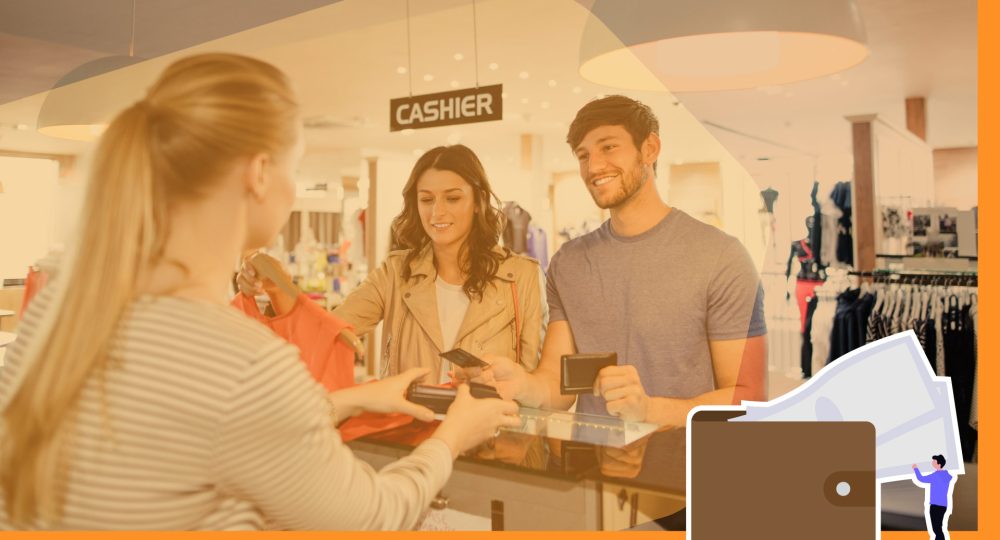


Suggestive selling in retail comes down to a moment on the sales floor. A shopper takes two pairs of jeans into the fitting room. In one store, an associate checks in, brings another size and suggests a belt. In another store, nobody comes. The shopper buys the jeans and leaves.
Both stores trained their teams on the same service approach. Only one associate followed it. In McKinsey’s 2026 research into physical retail, 76% of US consumers surveyed cited product guidance as a factor when choosing a store for browsing or discovery visits. Advice is part of why shoppers choose where to shop.
Your sales figures show the jeans. They can’t show whether anyone offered the belt, how often your associates make that offer, or what it adds to spend. Training teaches teams what to suggest. The next step is knowing whether they did.
What is suggestive selling?
Suggestive selling is when a store associate recommends an extra or alternative product based on what a shopper is buying or looking for. Some retailers call it suggestion selling. Examples include socks with running shoes, a belt with jeans or batteries with a toy.
The recommendation should serve a purpose. Someone buying shoes for a walking vacation might appreciate advice on suitable socks or a care product. A gift buyer may need help choosing an accessory that suits the recipient. An associate who listens first can match the suggestion to the shopper.
Suggestive selling vs upselling and cross-selling
Suggestive selling describes the behavior of making a recommendation. Upselling and cross-selling describe the type of recommendation.
| Technique | What it means | Retail example |
|---|---|---|
| Suggestive selling | Recommending a relevant product or alternative | Asking what the shoes are for, then suggesting the right socks |
| Upselling | Recommending a higher-value version of a product | Offering premium running shoes instead of the standard pair |
| Cross-selling | Recommending a complementary product | Suggesting running socks with the shoes |
A suggestion can involve either upselling or cross-selling. The shopper cares whether the advice helps them choose. For more examples of upselling and cross-selling, see our guide to retail sales.
Why a suggestion works in a store
Many shoppers enter a store without having decided what they will buy. At an off-price department store we work with, 39.1% of buyers said they came in just browsing (35,176 answers, January to September 22, 2026).
The proportion ranged between 37% and 42% each month. About three in ten buyers came for one item, while another three in ten had several things in mind. The figure covers buyers at one retailer. More than a third of those purchases began without a particular product in mind.
Gift buyers need help too. Across two apparel and footwear retailers we work with, 26.0% of buyers said they were buying for someone else (15,376 answers, February to June 2026). Someone shopping for another person may not know their size, preferences or what they already own.
There is research behind the value of that personal advice. A 2023 field experiment published in Psychology & Marketing found that younger shoppers with limited product knowledge experienced less choice overload and greater confidence when they consulted a store employee instead of searching for information on their phone.
The study measured decision confidence, not additional spending. But it helps explain why an associate who listens and narrows the options has a role that goes beyond finding products on a shelf. An associate who helps with that choice makes the purchase easier and can put one more item in the basket.
Gareth Johns, Chief Data Officer at TruRating, describes the need for a more active approach to service:
“It’s not a reactive service model. It has to be much more of a proactive sales model.”
Gareth Johns, Chief Data Officer, TruRating
Proactive means spotting the shopper who would welcome help, then offering it.
Techniques for store teams
Suggestive selling techniques start with retail associate training, product knowledge and service scripts. These give your teams a foundation. The Shopper Insights 2026 report sets out six behaviors that put them to work on the floor.
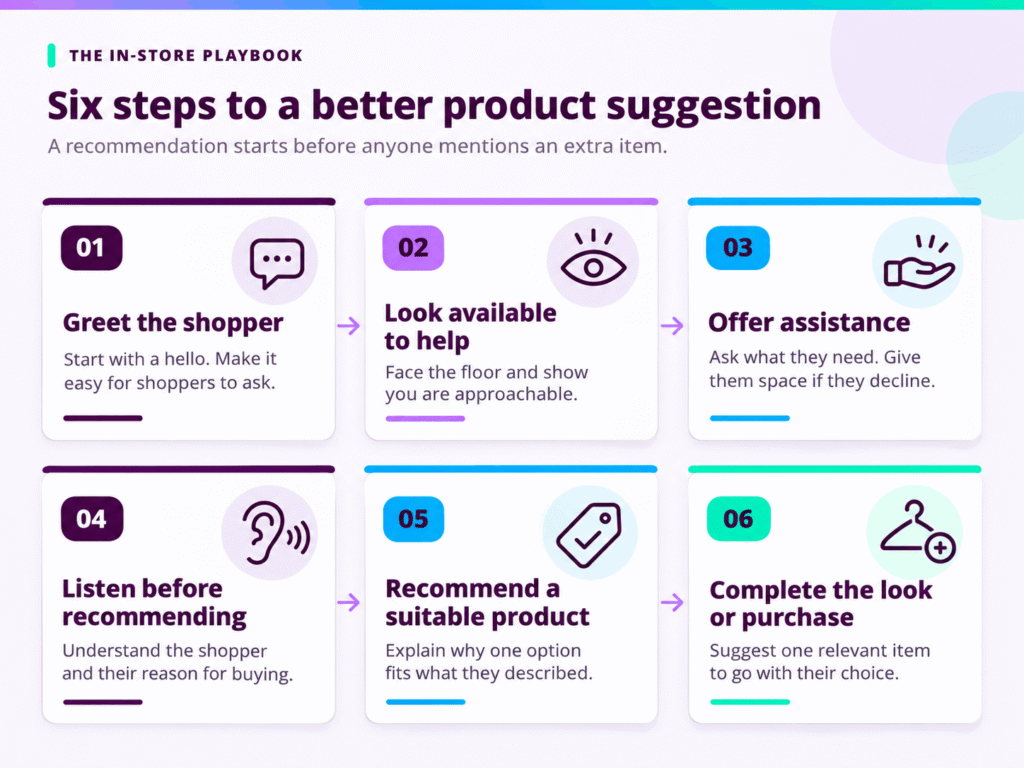
1. Greet the shopper
A greeting tells the shopper help is there. It also gives the associate a chance to understand whether the customer is browsing or looking for something in particular.
2. Look available to help
An associate restocking with their back to the aisle is on the floor but hard to approach. Eye contact and an open posture tell shoppers they can ask.
3. Offer assistance
Ask before the shopper has to. “Are you looking for something in particular?” or “Would you like help with sizes?” gives the shopper an easy opening. If they say no, let them browse.
4. Listen before recommending
Someone buying shoes for a long walk has different needs from someone choosing a pair for occasional wear. Listening helps the associate understand which products fit the occasion.
5. Recommend a suitable product
Once the associate understands the need, they can offer a recommendation. Tell the shopper in a sentence why it suits what they described.
6. Complete the look or purchase
Suggest a relevant additional item, whether that’s a belt with jeans, a matching top with a skirt or a care product with new shoes. Tie the suggestion to what the shopper told you, and offer one item.
Each behavior gives a store manager something to watch for and coach.
Suggestive selling examples from the sales floor
Suggestive selling examples change by category. Each one starts from what the shopper is buying.
- Apparel and fashion: an associate helping someone in the fitting room offers another size, then suggests a matching belt or jacket.
- Footwear: an associate offers someone buying running shoes suitable socks or a care product and explains how the additional item fits their needs.
- Travel retail and convenience: an associate suggests a travel adapter with an electronic device or a snack with a drink.
- Beauty: an associate shows a shopper choosing foundation a matching application product or a refill for an item they already use.
- Grocery: an associate helping someone find pasta suggests a suitable sauce or an ingredient for the recipe they are planning.
How visual merchandising supports suggestions
Visual merchandising can introduce complementary products before an associate speaks. A mannequin displays a complete outfit. Shoe care products sit beside footwear. A grocer groups the ingredients for a meal. These displays help customers see what goes together and give associates a natural reference when recommending another item. Neither tells you how often the suggestion happens in each store.
What a good suggestion is worth
Two TruRating clients measured moments of in-store assistance at payment and found different spending uplifts.
Paradies Lagardère: measuring item suggestions
Paradies Lagardère operates more than 700 retail stores and restaurants across 92 North American airports.
The retailer wanted to understand how often associates suggested additional products and what those suggestions contributed to spend.
By asking customers at payment whether a team member had suggested an item, Paradies found that customers who received a suggestion spent 10% more per transaction than those who did not.
Yet half its stores made the suggestion less than 60% of the time.
TruRating estimated a $1.8 million revenue opportunity if the bottom 50% of stores improved suggestion execution by 25 percentage points. That figure is a model, not revenue recovered.
Bill Pugh, Senior Director, Store Operations at Paradies Lagardère, said:
“It gave the right information to the right people, so they could build a plan, take action and influence store performance.”
Read the Paradies Lagardère case study.
Hanes Australasia: measuring fitting room assistance
For Hanes Australasia, whose brands include Bras N Things, Bonds and Sheridan, the focus was proactive fitting room assistance.
Across 41,000 ratings, ATV was 18% higher when associates offered fitting room help.
Hanes measured fitting room help as a whole, so the 18% covers more than suggestions.
Top stores offered that help far more often than lower-performing ones. Improving fitting room assistance for an additional 5% of customers represented an estimated 1% incremental revenue growth opportunity.
Hanes used the gap to target coaching in its lower-performing stores.
Read the Hanes Australasia case study.
The two studies measured different moments, and both found associations. Product mix, promotions and the shopper’s needs shape spending too. Compare similar stores and periods before drawing conclusions.
Your stores need their own read. For other ways to lift spend, see our report on how to increase ATV.
Measuring suggestions at payment
Your transaction data shows what each shopper bought, what they spent and which products sold together. It can’t show whether an associate suggested the extra item.
TruRating asks one anonymous question at payment:
“Did a team member suggest an item for you today?”
We link each answer to the verified purchase, with its value, store and time, so you can compare spend with and without a suggestion.
You can also see how often the behavior happens across locations, days and hours.
Find the stores where suggestions are missed
In the Shopper Insights 2026 webinar, Gareth Johns describes differences in how retail teams deliver service behaviors.
- Across stores: Execution of the later behaviors in the service sequence, including recommending products and suggesting additional items, can differ by 30 to 40 percentage points between stronger and weaker stores.
- Through the day: Within individual stores, execution can fall by around 10 percentage points from mid-morning to mid-afternoon, before improving toward the end of the day.
- Busy versus quiet: Execution often differs by only two to three percentage points.
So “we were too busy” explains little of the gap.
Gareth bases these observations on TruRating’s apparel clients. They aren’t industry benchmarks.
Suzanne Varigos, Head of Consumer & Customer Centricity at Hanes Australasia, made a similar observation about fitting room assistance:
“Even in our busiest stores, we see a clear uplift when the service approach is followed.”
Turn the findings into coaching
A field leader can find the stores where suggestions drop and coach the behavior there.
Your training and scripts still do the teaching. The answers show where to use them and whether execution improved.
Store managers can compare their location with similar stores, identify which shifts need attention and learn from teams that deliver the behavior more often.
See how TruRating’s point of payment feedback supports this approach, alongside practical guidance on coaching store teams.
The KPIs to track
Start with the suggestion rate, then read it alongside these four measures.
| KPI | What it tells you |
|---|---|
| Suggestion rate | The share of customers answering the payment question who report receiving a suggestion. Shows how often the behavior happens. |
| Average transaction value (ATV) | Compares spending when customers report a suggestion with spending when they do not. Shows the association with transaction value. |
| Units per transaction (UPT) | Tracks how many items customers purchase. Helps show whether additional-item recommendations appear in the basket. |
| Attachment rate | Measures how often a complementary product is purchased with the main item. Helps evaluate add-on opportunities. |
| Conversion rate | Measures the share of store visitors who purchase. Provides wider sales context, although payment feedback alone cannot measure the effect of suggestions on nonbuyers. |
A store might have a strong attachment rate because its merchandising encourages shoppers to pick up related products. Another might see higher spending when associates provide detailed recommendations.
Customer answers tell you which of the two you’re looking at.
Our guides cover average transaction value (ATV), conversion rate and other retail metrics in more detail.
Make good recommendations part of every store’s service
The techniques behind suggestive selling are familiar. Greet customers, understand their needs, recommend something relevant and help them complete their purchase.
The hard part is knowing whether it happens between store visits and training sessions.
TruRating connects customer answers collected at payment with transaction data. You see which stores make the suggestion, when it slips and how reported recommendations relate to spending.
The wider Shopper Insights 2026 report covers proactive service in more depth, including shoppers who arrive undecided and the gaps between stores. You can also watch Gareth Johns and Simon Hay discuss the findings.
Want to see which service behaviors are associated with higher spending in your stores?
Book a TruRating demo to see how transaction-linked customer feedback can help you measure execution and focus coaching across your stores.
Useful resources
- How to increase sales in retail
- How to increase ATV in retail
- Increasing retail revenue: One more item in the basket
- Retail coaching: How to improve store team performance
- Shopper Insights 2026: New pressures, new priorities
Frequently asked questions
Answers to common questions about suggestive selling in retail and how to measure it.