
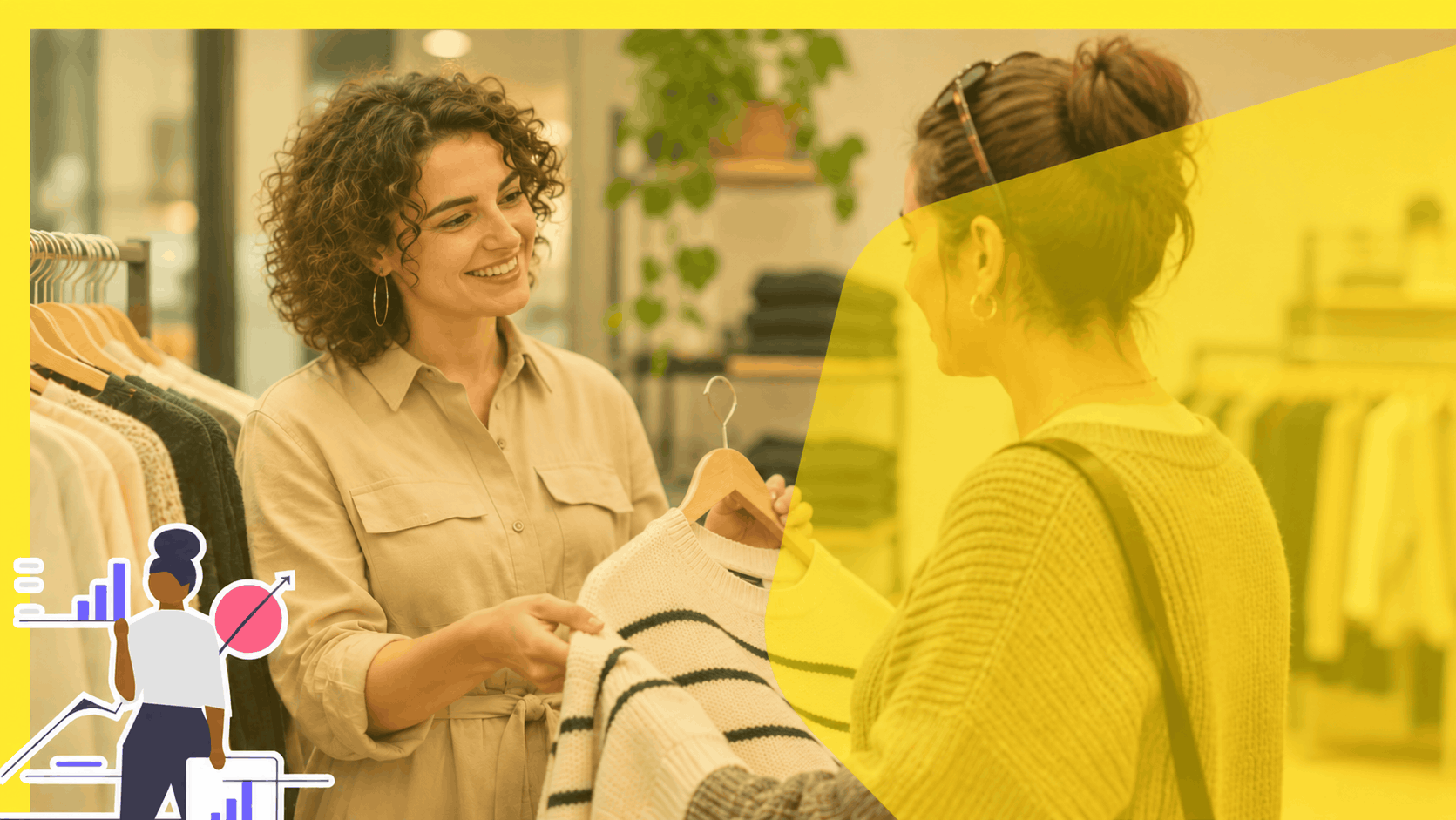
Imagine someone shopping for a sweater as a gift. They’re not sure about the size, and a little advice would help. In one store, a team member notices and offers a hand. In another, the shopper is left to figure it out alone, perhaps asking at the register or putting the sweater back.
That’s what proactive customer service looks like in practice. It’s about recognizing when someone might need help and starting the conversation before they have to ask.
And gift buying is a good example of why this matters. Across retailers we work with, 26.0% of shoppers said they were buying for someone else, based on 15,376 answers collected between February and June 2026. See the gift-buyer findings.
There’s a commercial reason to pay attention, too. Across a larger group of retailers we work with, shoppers who said a team member greeted them, offered help or made a recommendation spent a average of 12.05% more per transaction than shoppers in the same stores who didn’t receive that service.
The opportunity is to understand how often these interactions happen, where they’re happening consistently and where teams could be doing more.
What is proactive customer service?
Proactive customer service means anticipating a customer’s needs and offering help before they ask. A support team might warn someone about a delayed delivery. On the sales floor, an associate notices a shopper weighing up two products and asks if they’d like some advice.
It might mean greeting someone, offering another size or helping with a gift. The shopper stays free to decline. Proactive service makes help easy to find for shoppers who want it. It’s the part of the retail customer experience your store teams control.
Proactive vs reactive customer service
With reactive customer service, your team waits for the shopper to ask. With proactive service, the team starts the conversation. Waiting can miss the moment when help would be useful.
| Reactive service | Proactive service |
|---|---|
| Answers a question when someone approaches | Greets the shopper and offers help |
| Finds another size when asked | Checks whether another size would help |
| Advises a gift buyer at the register | Helps while the shopper is choosing |
| Explains products after a question | Offers guidance when someone is comparing options |
| Discusses an extra item if prompted | Suggests something relevant when appropriate |
As Gareth Johns, Chief Data Officer at TruRating, puts it:
“It’s not a reactive service model. It has to be much more of a proactive sales model.”
Gareth Johns, Chief Data Officer, TruRating
Shoppers can keep browsing or accept help without having to search for an associate.
Why going first pays in a store
Anticipating customer needs helps most when someone hasn’t decided what to buy. At an off-price department store we work with, 39.1% of buyers said they came in just browsing, based on 35,176 answers collected from January to September 2026. Those shoppers bought something, but they came in without a product in mind. See the browsing findings.
The wider research gives that store-floor moment context. For discovery visits, product guidance influenced store choice for 76% of consumers in research discussed on McKinsey’s retail podcast.
Gift buying makes the opportunity easier to picture. A shopper may not know the recipient’s size, preferences or what they already own. In Deloitte’s 2026 US holiday research, 26% of respondents said they rely on salespeople to find an appealing luxury gift, including 34% of Gen Z respondents.
Your team needs to spot the moment a question would help, even before they know what the shopper wants. For a gift buyer, “Who are you shopping for?” may be enough to get the conversation moving.
What shoppers spend when your team goes first
Across 14 retailers we work with, shoppers who reported that an associate greeted them, offered help, made a recommendation or suggested an item spent a average of 12.05% more per transaction than shoppers in the same stores who said that behavior did not happen. This covers 16,618,094 customer answers from November 2025 to October 2026.
The table compares shoppers in the same stores. Each figure shows the middle retailer in its group (the median).
| When a team member… | Shoppers spent | Retailers |
|---|---|---|
| Greeted them | 10.70% more | 13 |
| Offered help | 20.85% more | 6 |
| Made helpful recommendations | 11.69% more | 5 |
| Suggested an extra item | 10.86% more | 12 |
Every retailer in every group saw higher spend with the behavior. Offering help shows the biggest difference but comes from six retailers, the smallest group.
About the data
- Who: 14 retailers across apparel, sportswear, footwear, travel retail, discount variety, attraction retail and electronics in the US, Canada, Australia and New Zealand. The period is November 1, 2025 to October 31, 2026.
- What shoppers answered: Yes or No questions at payment. There were 11,884,194 answers about greeting, 884,754 about offering help, 639,488 about recommendations and 3,209,658 about extra-item suggestions, totaling 16,618,094.
- How spend was compared: Average spend per transaction (ATV) compares yes and no answers within the same store. For the 12.05% headline, each retailer’s figure averages the behaviors it asks about. The table reports each behavior separately. Figures shown are medians across retailers.
A shopper planning to spend more may also be more likely to receive help, so treat these as associations. For more on the measure, see what ATV means in retail and our report on how to increase ATV.
A fitting-room example from Hanes Australasia
At Hanes Australasia, customers spent 18% more when fitting-room help was offered, across 41,000 ratings analyzed. Hanes found a wide gap in fitting-room assistance between stores. It targeted coaching in its lower-performing stores. Suzanne Varigos, Head of Consumer & Customer Centricity, said:
“Even in our busiest stores, we see a clear uplift when the service approach is followed.”
Suzanne Varigos, Head of Consumer & Customer Centricity, Hanes Australasia
Read the Hanes Australasia case study to see how the retailer used customer answers to focus its teams.
Proactive customer service examples in retail
Proactive customer service examples are small things a manager can watch for. The best approach changes with the shopper and the store format.
A team member greets an arrival, stays approachable while restocking or checks whether another size would help. In electronics, an associate might explain the difference between two models. For a gift buyer, one question can narrow the choice.
An appropriate extra-item recommendation is another example. We cover that in more depth in our guide to suggestive selling in retail. Proactive service starts earlier, when someone notices a shopper who might need a hand.
How to greet customers in a store
Greeting customers well means opening the door to help without making anyone feel they have to stop. Three simple approaches are enough to give a team a starting point:
- A shopper arriving: “Hi, let me know if you’d like a hand with anything.”
- Someone searching an aisle: “Are you looking for something in particular?”
- A shopper choosing a gift: “Are you shopping for yourself or someone else?”
Keep the greeting light and follow up when someone seems unsure.
Customer service behaviors can look fine at retailer level and still vary between stores. At the median retailer in our analysis, 87.59% of shoppers reported being greeted. For suggestions of additional items, the median was 61.02%, so suggestions have more room to grow.
The difference between stores was much wider. At the median retailer, there was a 27.48 percentage-point gap between the highest and lowest stores for greeting. The equivalent gaps were 27.26 points for offering help, 24.49 points for helpful recommendations and 49.12 points for suggesting an additional item.
That nearly 50-point suggestion gap raises an obvious coaching question: what do the top stores do differently?
Hours varied far less. Between 9 a.m. and 9 p.m. local time, the median gap between a retailer’s highest and lowest hour was 5.08 points for greeting, 5.34 for help, 3.29 for recommendations and 7.49 for extra-item suggestions. The best-to-worst gap between stores was around five to seven times the gap between hours, so start with the stores, then check the hours inside each one.
About the store comparison
- Stores included: Locations with at least 300 answers at retailers with at least 10 qualifying stores. Each comparison is between stores belonging to the same retailer.
- Checking the spread: Excluding the top and bottom 10% of stores still left gaps of 12.18 points for greeting, 13.81 for help, 8.80 for recommendations and 22.31 for extra-item suggestions.
How to build a proactive service model
To improve proactive customer engagement, turn “give great service” into behaviors people can recognize, measure and coach.
- Choose what good service looks like: define a few actions that fit the format. An apparel store might focus on greeting and fitting-room assistance; an electronics retailer might focus on offering product guidance.
- Ask shoppers what happened: use a short question at payment to find out whether they were greeted, offered help or given a suggestion. Point-of-payment feedback can connect the answer with the purchase.
- Compare stores with the right reference: start with your own store median, then use the benchmarks above as context. Look for differences that hold across weeks.
- Coach the specific behavior: if shoppers regularly report that help was not offered, focus on when and how associates approach. McKinsey suggests that discovery-led stores may need more specialized product expertise and coaching than convenience-led locations. Our retail coaching guide looks at making that practical.
- Look at the hours inside each store: once you know where the biggest gaps are, check whether busy periods or staffing patterns coincide with lower service rates. Test a change and measure again.
Coaching also depends on how teams feel about the job. In an analysis of more than 100 retailers, McKinsey found that companies with a top-quartile employee experience were more than twice as likely as others to achieve a top-quartile customer experience.
KPIs for proactive service
Use a small set of measures that links service delivery with the purchase. The wider set of customer service metrics is useful, but these five keep the focus on what happens on the store floor.
| Measure | What it tells you |
|---|---|
| Behavior rate | How often shoppers say the action happened |
| Spend with and without | Whether average spending differs when it happens |
| Gap between stores | Where service is most and least consistent |
| Gap between hours | When a store may need more support |
| Conversion, with footfall data | Whether service patterns track the share of visitors who buy |
Look at the measures together. A strong greeting rate alongside a weaker assistance rate points to a different coaching need than a low greeting rate.
Make the first move count
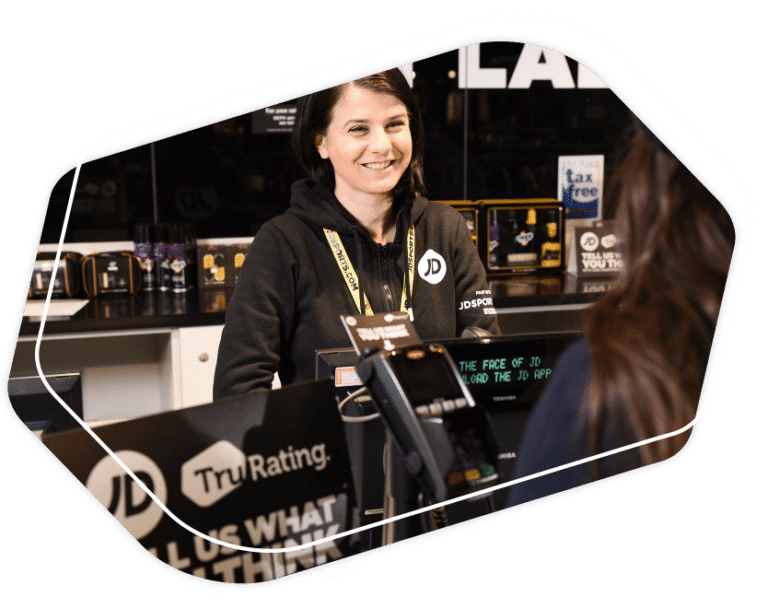
TruRating asks one anonymous question at payment, while the visit is still fresh. On average, 84% of in-store customers answer, so you hear from enough shoppers to see each store and shift. Every answer arrives joined to the purchase. That shows what shoppers spent when a team member greeted them, offered help or suggested an item, and what they spent when nobody did.
Our TruDI (TruData Intelligence) AI Analyst and our retail experts turn that into a next step: which behavior to coach, in which stores, and what closing the gap is projected to be worth. They also show which stores to recognize for getting it right. Your managers go into the next coaching conversation with the store, the shift and the action already named.
Explore the Shopper Insights 2026 report, watch the webinar or book a demo to see how the approach works across stores. You can also read our wider guide to ways to increase sales in retail.
Useful resources
- Shopper Insights 2026 Report
- How to Improve Customer Experience in Retail Stores
- Suggestive Selling in Retail
- Retail Coaching: How to Improve Store Team Performance
- How to Measure Customer Service
Frequently asked questions
Straight answers about proactive service in stores, from greetings to measuring what shoppers spend.