
Retail growth strategies in 2026 do not get funded on intent. Customers are more value-led, cost lines remain volatile, and boards want growth and margin. Deloitte’s outlook captures the mood. Most retail executives expect revenue growth, while a large majority are also targeting margin expansion in the same year. The issue is timing. Most initiatives are assessed when the numbers land. The P&L tells you what happened, but it doesn’t isolate incrementality, explain demand shifts, or show whether execution held steady across stores and shifts.
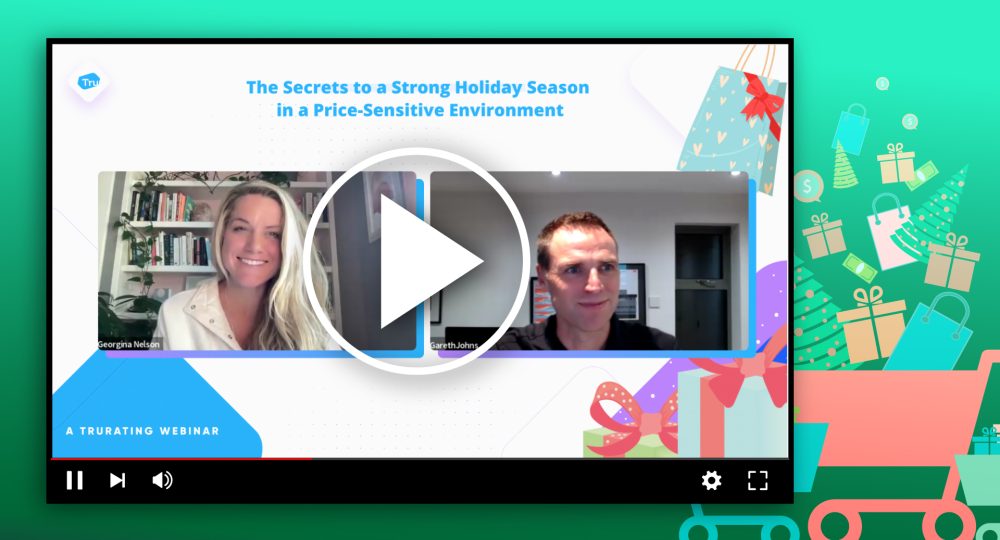
That was the core message from our recent webinar with Georgina Nelson, Founder and CEO of TruRating, and Simon Hay, former CEO of dunnhumby and one of retail’s most experienced data leaders. Their conversation focused on what executive leaders in retail are asking for right now – proof of incrementality, better control over execution, and stronger data to support faster decisions.
Watch retail growth strategies for executive leaders
Key takeaways for retail sales growth strategies
The biggest lesson from the session is that retail sales growth strategies still rise or fall on execution. Strategy can look strong in the boardroom, but once it reaches stores, shifts, and regions, the gaps appear.
Georgina opened with a simple point that retail is moving fast on AI, automation, and efficiency, but execution is still mostly human. And that matters. Even the best growth strategy will underperform if store-level delivery is inconsistent. That is why averages can be misleading. A pilot can look fine at headline level while breaking down in certain stores, dayparts, or formats. By the time that shows up in lagging KPIs, time and budget have already been lost.
“Ultimately, we see gaps of about 50% between the top-performing stores and the bottom-performing stores. And it’s really very much of how can we close that gap in execution.”
— Georgina Nelson, CEO & Founder, TruRating
Why retail business growth strategies now depend on better data
Retail business growth strategies now depend less on having more dashboards and more on having better source data. Simon made that point clearly in the discussion on AI. The opportunity is real, but so is the risk.
AI can help retailers analyse faster, simplify work, and improve decision speed. But it can also scale bad inputs faster. If the underlying data is weak, delayed, or disconnected from what customers actually experienced, the output may still look convincing while pushing the business in the wrong direction.
That is why data quality and data integrity matter so much. Retailers need to understand where data comes from, what it tells them, what it misses, and what happens when it is transformed or modelled. If the fuel is wrong, the AI is wrong too.
The discussion also pushed beyond technology. One of the clearest warnings was that AI adoption is not just a tooling issue. It is a people and process issue. Retailers cannot assume there are neat “AI-shaped holes” in the organization. To make AI work, teams need to break down silos, raise internal capability, and align around where AI can genuinely improve outcomes.
“When people ask me what’s the biggest challenge with AI, my answer is always humans… If you get the fuel wrong, the AI’s wrong, and then you start multiplying your problems from there.”
— Simon Hay, ex-CEO, dunnhumby
Why retail transaction growth strategies need real-time customer signal
Retail transaction growth strategies work better when leaders can see what happened in the moment, not weeks later. That was one of the strongest themes in the webinar.
Simon highlighted the value of asking questions at the point of payment, because delayed surveys, low response rates, and broad experience scores often miss the actual drivers of spend and return behavior. When feedback comes too late, it is harder to trust, harder to localize, and harder to act on.
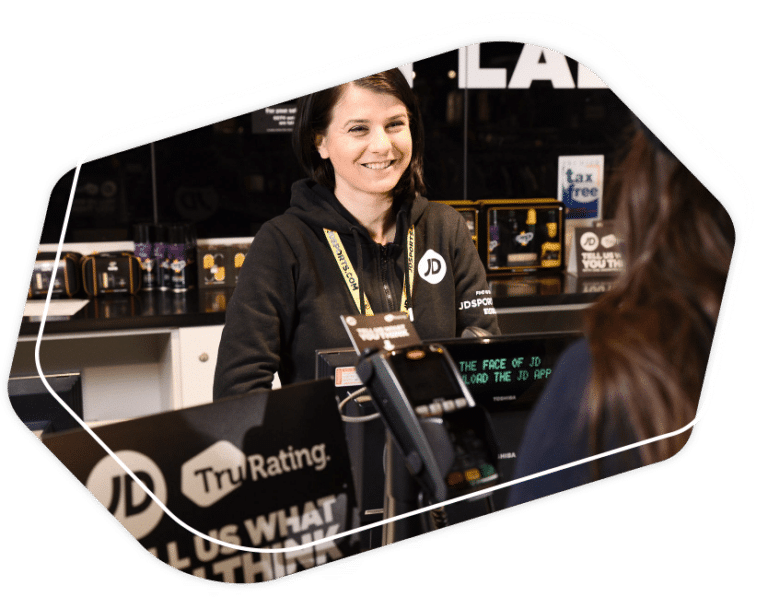
This is where TruRating’s model stands out. By collecting feedback at checkout, tied to the transaction, retailers can understand not just what sold, but what happened around the sale.
- Were customers greeted?
- Could they find what they needed?
- Did service behaviors support conversion, basket size, or repeat intent?
That link between customer feedback and transaction data gives leaders a much clearer view of what is really driving performance. It also gives them a better way to spot execution variance. If one store is consistently converting better, or lifting ATV through stronger service behaviors, that becomes visible sooner. And if another store is underperforming because of friction in layout, checkout, or staff availability, that becomes easier to isolate before the problem spreads.
“You’ve got the chance to ask a question at the moment of reality.”
— Simon Hay, ex-CEO, dunnhumby
What a revenue growth strategy for retail needs in 2026
A strong revenue growth strategy for retail needs faster proof, tighter validation, and better discipline around where to scale. That came through clearly in the webinar’s discussion on promotions, loyalty, and pilot decision-making.
Retailers cannot keep relying on broad discounting or broad initiatives and assume they are creating real value. Promotions can lift sales while masking substitution, forward-buying, or margin dilution. Loyalty can drift into becoming a standing discount layer rather than a driver of long-term value. And new formats or service models can look successful in aggregate while failing in specific stores.
The better question is whether the initiative changed customer behaviour in the right way:
- Did it improve conversion?
- Did it increase basket size?
- Did it lift repeat visits?
- Did it reduce friction in a way customers actually noticed?
Those are much more useful questions than headline sales alone.
Georgina also made an important point here about test-and-learn. Retailers now have access to real-time data that can help them validate innovation earlier. That means they do not need to wait months to understand whether an initiative is creating revenue opportunities or exposing execution gaps. They can test, measure, and decide in days or weeks.
“It’s about being able to test and learn quickly, see the impact on customer behavior, and know whether to scale or stop.”
— Georgina Nelson, CEO & Founder, TruRating
Why first-party data is becoming more urgent
Another important point from the webinar was the growing role of first-party data. As agentic AI and assisted commerce develop, retailers risk losing direct connection with the customer if they do not build stronger data assets now.
Simon made the point plainly. If agents start shaping more of the shopping journey, retailers need to be much better at listening to customers, understanding behavior, and organizing first-party data while they still have the relationship. Once that connection weakens, it becomes much harder to win back.
“You’ve got to make sure that you’re absolutely brilliant in store today, and you’re getting the data and the understanding in the right places to drive your decision-making.”
— Simon Hay, ex-CEO, dunnhumby
What the 2026 retail outlooks still agree on
Across the 2026 outlooks, the same constraints show up. Value-led consumers, margin pressure, labor and cost disruption, accelerated AI adoption, and shorter decision cycles.
1) Value is a baseline
Barclays’ 2026 retail outlook points to cautious shoppers and value-for-money staying central, with more “savvy” behaviours around deal-seeking and price scrutiny. TruRating’s own consumer polling shows how widespread that behavior has become. In our Holiday Trends Guide 2025 (23,000+ shoppers across grocery, convenience, fashion and luxury), 78% said price is more top of mind than before. 67% said prices have increased recently (rising to 70% in grocery). And 74% in general retail and 79% in grocery said they’re doing more price comparison.
2) Execution should be the focus
KPMG’s NRF 2026 takeaways highlight familiar priorities like personalization and frictionless experiences. The operational reality underneath them matters more, as performance advantage comes from repeatable execution across formats, regions, and shifts.
When execution varies, ROI becomes noisy. Promotions don’t land consistently, loyalty adoption becomes patchy, and the same initiative produces different outcomes by store. That’s not a marketing problem. It’s a controllability problem.
3) AI is moving fast, whereas governance is still lagging
NRF’s 2026 trends point to AI becoming embedded across retail. The governance issue is not “whether to invest”, it’s about which decisions AI influences and how those decisions are validated. AI speeds up analysis, but it also speeds up decisions. As discussed in the webinar, without quality data, it can lead to wrong assumptions with huge financial consequences. That’s why governance needs to catch up.
4) Cost pressure is forcing operating model choices
For retail leaders, 2026 adds another constraint in labor economics. PwC’s Retail Outlook 2026 frames growth decisions against economic uncertainty and shifting consumer confidence. At the same time, the BRC’s survey of retail CFOs shows that 52% plan to reduce hours/overtime, 32% plan to freeze recruitment, 48% plan to reduce head office headcount, and 32% plan to reduce store headcount, while 68% push for productivity gains and 61% invest in automation.
That constraint changes what “growth strategy” can realistically depend on. If the plan assumes perfect service levels or extra labor, it’s fragile. Capacity and consistency become the limiting factors.
What they all agree on
The common thread is that strategies need faster validation loops. A strategy that cannot be measured early becomes a rollout risk. A pilot without clear success criteria becomes hard to defend. And a decision delayed too long becomes its own problem.
Simon’s closing advice captured this well. Retailers need to do two things at once. Keep the business simple and consistent today. And at the same time, move decisively into a more data-led, AI-enabled future. It is not one or the other. It has to be both.
“You’ve got to keep it simple and execute. But at the same time, dive into the world of complexity and difficulty to solve the challenges of AI.”
— Simon Hay, ex CEO, dunnhumby
Final thought
The pressure on retail leaders is not just to find growth. It is to find growth that can be proven, repeated, and scaled. That is especially true for strategy and operations leaders who are under pressure to validate pilots faster, reduce rollout risk, and replicate what top-performing stores do differently.
That is why the strongest retail growth strategies in 2026 will be built on better insights, not bigger claims. They will use real-time customer feedback, tied to transaction outcomes, to show what is working, where it is working, and whether it is worth scaling.
That is also where TruRating has a clear role to play. It helps retailers move faster from hypothesis to proof, close the gap between strategy and store execution, and make better growth decisions with evidence instead of assumption.
Learn how our customer feedback platform helps you understand what’s really driving growth, or book a demo with our team.
Useful resources
- How to increase sales in retail – 24 practical strategies
- Perceived value in retail – how experience shapes pricing, loyalty, and spend
- Retail conversion guide – definition, formula, benchmarks, fixes
- How to measure customer service – metrics and tools
- Real-time feedback and customer experience – the new standard for retail
- How to improve customer experience in retail stores